Why Black Holes Don’t Actually Suck In Everything
Every year, a few headlines warn that a newly discovered black hole is racing toward Earth, ready to swallow the planet whole. The stories rarely hold up, but they persist because they tap into a widespread and inaccurate idea: that black holes function like cosmic vacuum cleaners, reaching out across space to pull in anything nearby.
The truth is both simpler and stranger. A black hole’s gravity works exactly the way any other object’s gravity does, following the same rules that keep the Moon in orbit around Earth and Earth in orbit around the Sun. What makes a black hole extraordinary isn’t a special suction power. It’s what happens to space and time once matter crosses a boundary called the event horizon, a point of no return that exists nowhere else in the universe.
This distinction matters because it separates real physics from popular myth. Understanding it means understanding why a star can orbit a black hole for millions of years without falling in, why our own solar system is in no danger from the black hole at the center of the Milky Way, and why the one genuinely irreversible danger only begins at a boundary most objects never approach.
Gravity Doesn’t Change Just Because a Black Hole Is Involved
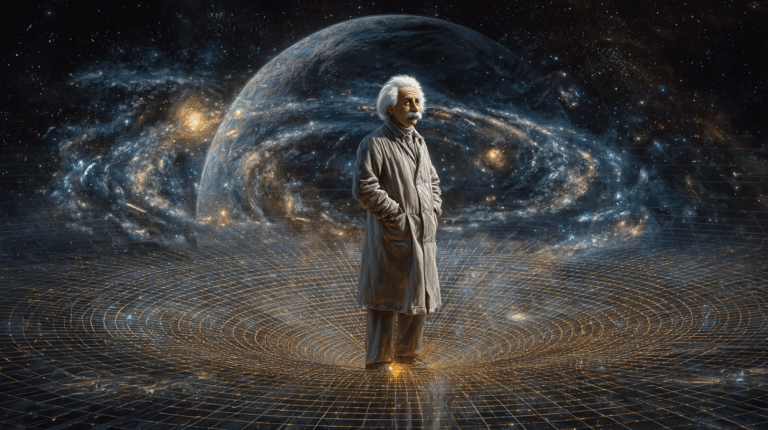
Every object with mass exerts a gravitational pull, and that pull depends on two things: how much mass the object has, and how far away you are from it. This relationship, first described mathematically by Isaac Newton and later refined by Einstein’s general relativity, applies to black holes exactly as it applies to stars, planets, or asteroids.
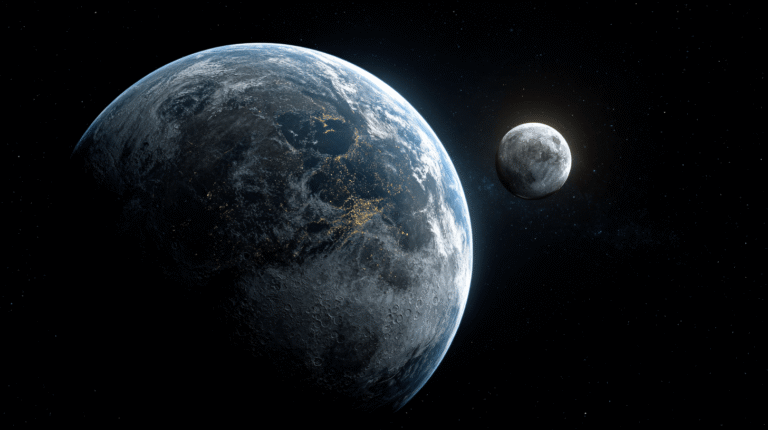
If the Sun were somehow replaced by a black hole of identical mass, Earth’s orbit would not change. The planet would continue circling at the same distance, following the same path, because the gravitational force at that distance depends only on the mass involved, not on what kind of object is producing it. Earth would grow cold and dark without sunlight, but it would not be pulled in any faster than it already orbits.
This is the first misconception to clear away. Black holes are not gravitational anomalies that reach out with greater strength than their mass would normally allow. A black hole with the mass of our Sun has the same gravitational influence, at the same distance, as the Sun itself. The danger black holes pose isn’t about reach. It’s about what exists very close to their center.
The Boundary That Makes Black Holes Different
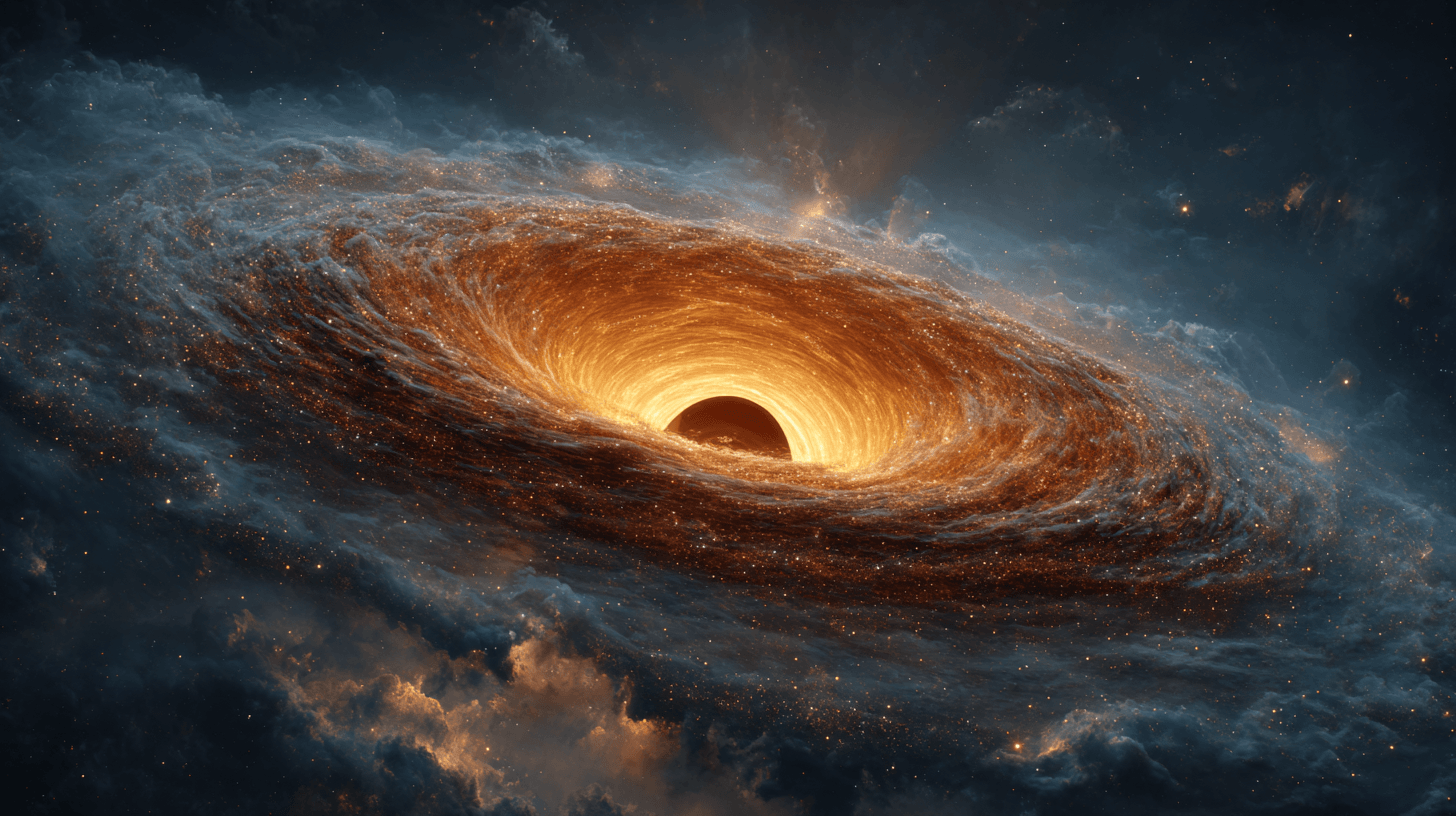
What actually sets a black hole apart is a boundary called the event horizon. Inside this boundary, the gravitational pull becomes so extreme that nothing, not even light, can travel fast enough to escape it.
Escaping any gravitational field requires reaching a specific speed, known as escape velocity. Rockets leaving Earth need to reach about 25,000 miles per hour to break free of the planet’s gravity. Around an ordinary star, the escape velocity at the surface is higher but still finite. Around a black hole, the required escape velocity at the event horizon exceeds the speed of light itself, which physics treats as an absolute limit. Since nothing can travel faster than light, nothing that crosses the event horizon can turn back.
This is the real distinction between a black hole and every other object in the universe. Stars, planets, and moons all have surfaces, however extreme, that allow escape if you have enough energy. A black hole has a boundary from which escape is not merely difficult but physically impossible, given everything scientists currently understand about the laws of nature.
Outside that boundary, though, a black hole behaves like any massive object. Matter orbiting several event horizon radii away is not being dragged inward any more urgently than it would be by a star of equal mass. The extreme behavior is confined to the region closest to the center.
Why Matter Usually Orbits Instead of Falling In
If black holes worked like the popular image suggests, every star and gas cloud near one would eventually spiral to its doom. In reality, most matter near a black hole does something else entirely: it orbits, often for extraordinarily long periods, in patterns astronomers can observe and measure with precision.
The star S2, for example, orbits the supermassive black hole at the center of the Milky Way, known as Sagittarius A*, completing one loop roughly every 16 years. Astronomers have tracked its path since the early 1990s, and it shows no sign of spiraling inward. Sagittarius A* itself has a mass estimated at about 4 million times that of the Sun, yet stars throughout the galactic center continue orbiting it in stable, predictable patterns, the same way planets orbit a star.
Material does eventually fall into a black hole under certain conditions, usually when it loses angular momentum through collisions, friction, or interactions with other matter. Gas and dust in an accretion disk spiral inward gradually, heating up and emitting radiation as they lose energy, rather than being yanked in directly. This process can take an extremely long time, and much of the matter in a stable orbit around a black hole may never fall in at all.
The picture that emerges from decades of observation is not one of relentless consumption but of gravitational choreography, with black holes anchoring orbital systems in much the same way ordinary massive stars do.
What Actually Happens If You Cross the Line
The one place where black holes behave in a way nothing else in the universe does is inside, or very near, the event horizon. Here, the popular fears about black holes are not exaggerated. They are, if anything, understated, because the reality is stranger than most descriptions suggest.
As an object approaches a black hole, the difference in gravitational pull between its near side and far side becomes extreme. Near a stellar-mass black hole, this difference, called tidal force, would stretch a human body into a thin strand of matter long before reaching the event horizon, a process astrophysicists have nicknamed spaghettification. Around a supermassive black hole, tidal forces at the event horizon are much gentler, since the horizon itself is far larger and gravity changes more gradually across that distance. In principle, an object could cross the event horizon of a very large supermassive black hole without being torn apart immediately.
What happens after crossing is where physics reaches its current limits. General relativity predicts that all paths inside the event horizon lead toward a singularity, a point where the equations that describe gravity, space, and time stop producing meaningful answers. Physicists broadly agree that this signals a breakdown in our understanding rather than a literal infinitely dense point, but no confirmed theory yet describes what actually occurs at these extreme scales. This is one of the most active problems in theoretical physics.
Common Misconceptions Worth Correcting
Two ideas about black holes appear constantly in casual conversation, and both deserve direct correction.
The first is the notion that a black hole could unpredictably wander through space and threaten nearby star systems. Black holes move according to the same orbital mechanics as any other massive object. They don’t drift erratically or accelerate toward matter beyond what their mass and distance dictate. The nearest known black hole to Earth is roughly 1,560 light-years away, and its gravitational influence at that distance is negligible.
The second is the idea that a black hole’s pull strengthens dramatically the closer it is studied, as though proximity alone increases danger in some special way. In truth, danger increases the same way it would around a very massive star of equal size: gravity intensifies as distance decreases, following the same inverse-square relationship that governs every gravitational interaction in the universe. What changes is not the nature of gravity, but how close an object can get before it reaches a boundary from which return becomes physically impossible.
Black Holes Also Lose Mass, Slowly
Perhaps the most counterintuitive fact about black holes is that they aren’t perfectly permanent traps. In 1974, physicist Stephen Hawking proposed that black holes emit a faint form of radiation, now called Hawking radiation, caused by quantum effects near the event horizon. Over immense timescales, this radiation causes black holes to lose mass and, in principle, eventually evaporate entirely.
For any black hole formed from a collapsing star, this process would take vastly longer than the current age of the universe, so it has never been directly observed. Hawking radiation remains a theoretical prediction, though one supported by widely accepted physics, rather than a confirmed observation. Still, its existence undercuts the idea of black holes as objects that only grow and consume. Even the most extreme structures in the universe appear to have a slow, quiet decline built into their nature.
What This Reveals About How We Think About the Universe
The myth of the all-consuming black hole persists partly because black holes are genuinely unfamiliar, and the mind tends to fill unfamiliar territory with exaggerated danger. It also persists because science communication sometimes prioritizes drama over precision, turning a fascinating but well-understood gravitational boundary into a monster from outside physics.
The corrected picture is, in some ways, more remarkable than the myth. Black holes aren’t breaking the rules of gravity. They are demonstrating what those rules predict when mass becomes concentrated enough that a genuine point of no return appears in the universe for the first time. Stars orbit them. Galaxies form around them. Light bends near them in ways that let astronomers photograph their silhouettes, as the Event Horizon Telescope did in 2019 with the black hole at the center of the galaxy M87.
Black holes don’t reach out to pull in everything nearby. They simply mark the place where the ordinary laws of gravity produce an extraordinary result: a boundary that, once crossed, allows no way back.