What Plato’s Allegory of the Cave Reveals About Reality and Knowledge
Imagine spending your entire life watching shadows flicker on a wall and believing they were the only real things in existence. You would name them, argue about them, and build your understanding of the world entirely around them. You would have no reason to suspect that anything else existed, because shadows were all you had ever known.
This is the scenario Plato asks his readers to imagine in one of the most influential passages in Western philosophy: the Allegory of the Cave. Written around 375 BCE in Book VII of his dialogue The Republic, the story is narrated by Socrates to a young man named Glaucon, Plato’s own brother. It is not simply a colorful metaphor. It is Plato’s attempt to answer a difficult question: what does it actually mean to know something, and how would a person react if they discovered that everything they believed was only a partial and distorted version of the truth?
The allegory has outlived its original context by more than two thousand years, resurfacing in theology, political theory, and even science fiction. Understanding why requires looking past the image of chained prisoners and asking what problem Plato was actually trying to solve.
The Story Socrates Told
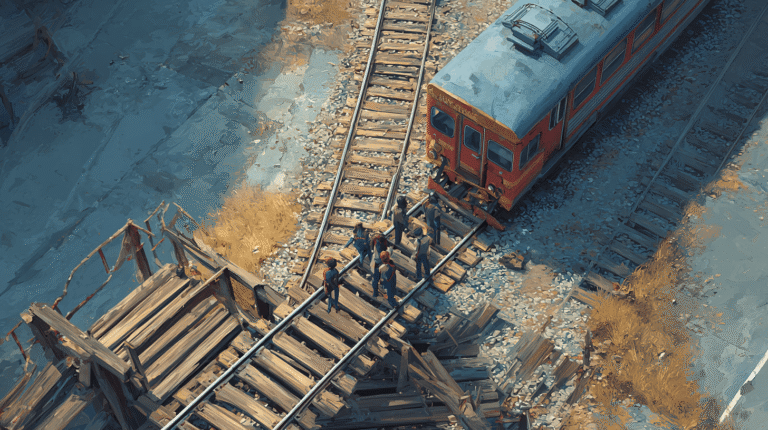
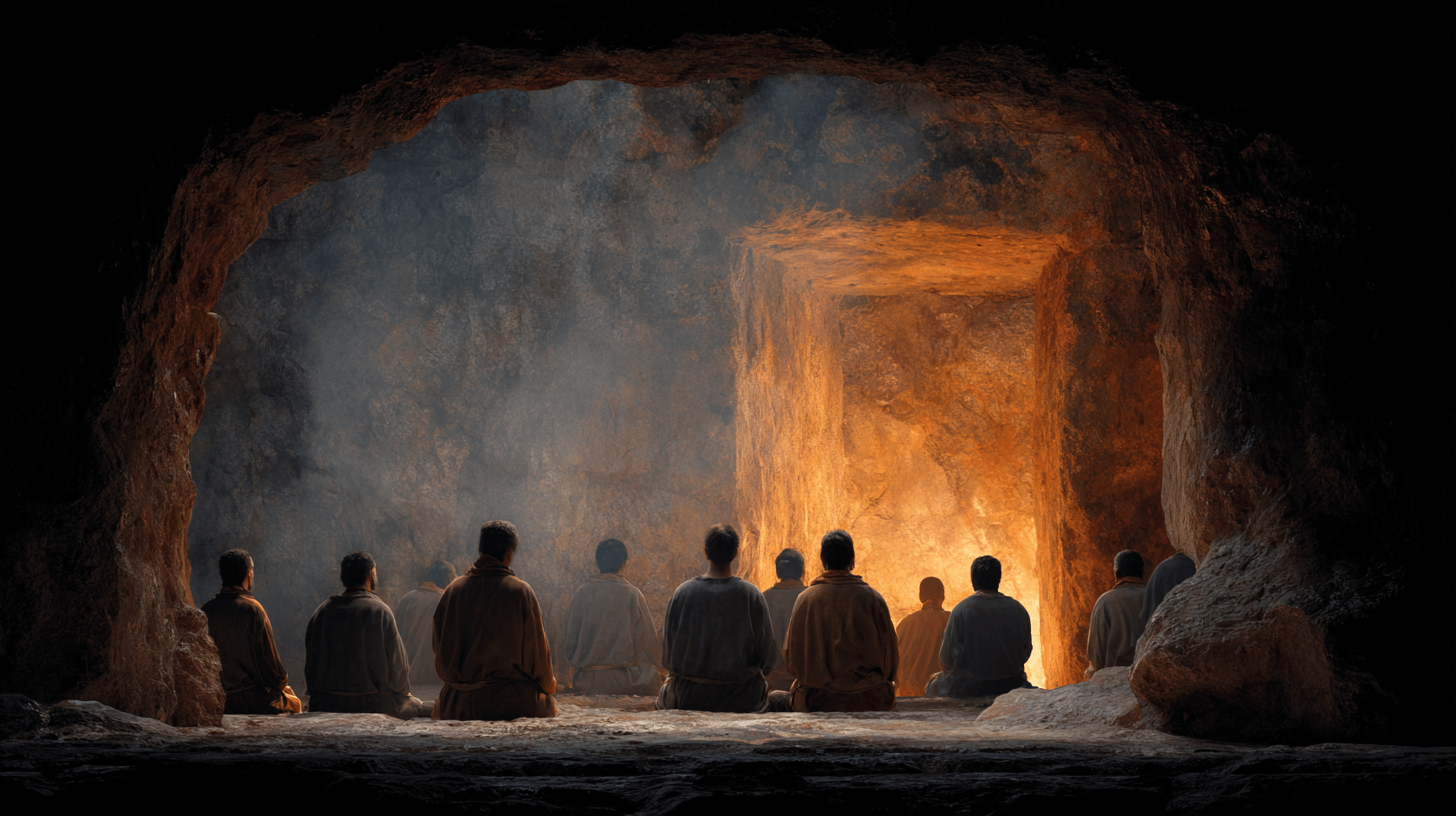
Socrates describes a group of people who have been chained inside a cave since childhood. Their legs and necks are restrained so that they can only look straight ahead at a blank wall. Behind them burns a fire, and between the fire and the prisoners runs a raised path. Along this path, unseen figures carry statues, cutouts, and objects shaped like animals and people, holding them up so that the firelight casts moving shadows onto the wall.
The prisoners have never seen the fire, the walkway, or the objects themselves. All they perceive are the shadows, along with echoes of voices that seem to come from the wall. For these prisoners, the shadows are not a symbol of anything else. The shadows are reality, in the only sense the word has ever had for them.
Socrates then asks Glaucon to imagine that one prisoner is freed and forced to turn around. The turning itself is painful, both physically and mentally, because the fire is blinding after a lifetime spent facing the opposite direction. At first the freed prisoner cannot make sense of what he sees. The objects casting the shadows seem less real than the shadows themselves, precisely because they are unfamiliar.
Gradually, if he is dragged farther out of the cave into daylight, his eyes adjust. He first tolerates shadows and reflections in water, then physical objects, then the night sky, and only at the end can he look directly at the sun. In Plato’s telling, the sun represents the highest object of understanding, which he calls the Form of the Good. Just as the sun makes ordinary sight possible and gives things their visibility, the Good is what makes genuine knowledge and truth possible at all.
Why Plato Needed This Image
Plato was not simply telling a story about eyesight. The cave sits at the end of a longer argument developed across Books VI and VII of The Republic, where Plato has already introduced two related ideas: the analogy of the sun and the metaphor of a divided line. Together, these three images form a single argument about the structure of knowledge itself.
The Limits of the Senses
Plato’s central claim is that the physical world we perceive through our senses is unstable and constantly changing. A beautiful object today may seem ordinary tomorrow. A fair action in one situation may seem unfair in another. If knowledge required a fixed and unchanging object, Plato argued, then the physical world could never fully provide it, because everything in it is subject to change, decay, and perspective.
This is what the shadows represent. They are not lies exactly, but they are the least reliable form of contact with reality: secondhand impressions of secondhand objects, several steps removed from anything permanent.
The Theory of Forms
Plato proposed that behind the changing world of physical things exist unchanging, non-physical realities that he called Forms. There is no perfect circle to be found anywhere in the physical world, yet mathematicians reason confidently about perfect circles. Plato argued that this is only possible because the mind has some access, however imperfect, to the Form of the Circle itself, a perfect standard that no drawn circle ever fully achieves.
Justice, beauty, and goodness worked the same way in his account. Particular just actions come and go, but the Form of Justice, on his view, does not change. The ascent out of the cave is Plato’s picture of the philosopher’s education: a slow, often uncomfortable movement away from opinions based on appearances and toward genuine understanding of these stable Forms.
The Ascent Out of the Cave
The physical difficulty of the climb in the allegory is deliberate. Plato describes the path out of the cave as steep and rough, and the prisoner’s ascent as something closer to being dragged than freely chosen. Learning, in his view, is rarely comfortable. It requires giving up beliefs that once felt secure.
Plato also insisted that education is not a matter of pouring knowledge into an empty mind, the way water is poured into an empty cup. He described it instead as a turning of the soul, redirecting a capacity for understanding that a person already possesses toward the right object. The Greek term he used, periagoge, literally means a turning around, the same physical motion the freed prisoner has to make to face the fire.
This distinction matters because it changes what a teacher is supposed to do. A teacher, on Plato’s account, does not install facts. A teacher redirects attention that was previously fixed on the wrong things.
The Return Nobody Wants to Make
The most unsettling part of the allegory comes after the philosopher has seen the sun. Socrates asks Glaucon to imagine that this enlightened person returns to the cave to tell the other prisoners what he has seen.
His eyes, adjusted now to daylight, struggle in the darkness. He stumbles and misjudges the shadows that the other prisoners can identify instantly. To them, he looks worse off than before he left, not better. Socrates suggests that the prisoners would mock him, insist that his journey had ruined him, and would kill anyone who tried to free them and drag them toward the light, if they had the power to do so.
Many scholars read this final detail as a pointed reference to the death of Socrates himself, who was tried and executed by an Athenian jury in 399 BCE after being accused of corrupting the youth of the city. Plato had watched his teacher put to death for questioning commonly held beliefs, and the allegory reads, in part, as an explanation of why that happened. Those who claim to see more clearly are not always welcomed. Sometimes they are punished for it.
What Popular Retellings Get Wrong
The cave is often summarized as a simple lesson about ignorance versus enlightenment, with the clear implication that anyone can choose to leave the cave if they try hard enough. Plato’s own version is considerably less optimistic. In his account, prisoners do not free themselves. Someone else does the freeing, and the ascent that follows is described as forced and painful rather than voluntary and pleasant.
The allegory is also frequently treated as a purely psychological metaphor, a call to think for oneself and question assumptions. That reading captures something real, but it strips away the political dimension that Plato placed at the very center of the story. For Plato, the point was never simply that individuals should seek truth. The point was that a just society specifically needs rulers who have made this difficult ascent, and that ordinary political ambition tends to attract exactly the wrong kind of person for the job.
The Philosopher’s Political Burden
In the argument surrounding the allegory, Plato claims that anyone who has genuinely seen the Form of the Good will be reluctant to return to ordinary political life. Ruling a city, adjudicating petty disputes, and competing for status all seem small and unappealing compared to contemplating unchanging truth.
Yet Plato insists that these are precisely the people who must be compelled to rule, because they are the only ones who will govern for the sake of the common good rather than for personal advantage. This is the philosophical foundation for Plato’s famous and controversial proposal that ideal cities should be led by philosopher-kings: rulers selected not for wealth, charisma, or popularity, but for having completed this arduous education.
This claim did not go unchallenged even in antiquity. Plato’s own student, Aristotle, later argued in his Metaphysics that separating Forms from the physical things that supposedly participate in them creates more philosophical problems than it solves. If a Form of Justice exists independently of just actions, Aristotle asked, what exactly connects the two? The debate over how literally to take the theory of Forms has continued among philosophers ever since, and there is no single settled answer.
Why the Cave Still Explains Modern Life
The allegory’s continued relevance rarely rests on accepting Plato’s full metaphysical picture. Few contemporary philosophers argue for a separate realm of perfect Forms in the way Plato described it. What has endured is the more general structure of the story: the unsettling possibility that a person’s entire picture of reality could be shaped by something other than reality itself, without that person ever suspecting it.
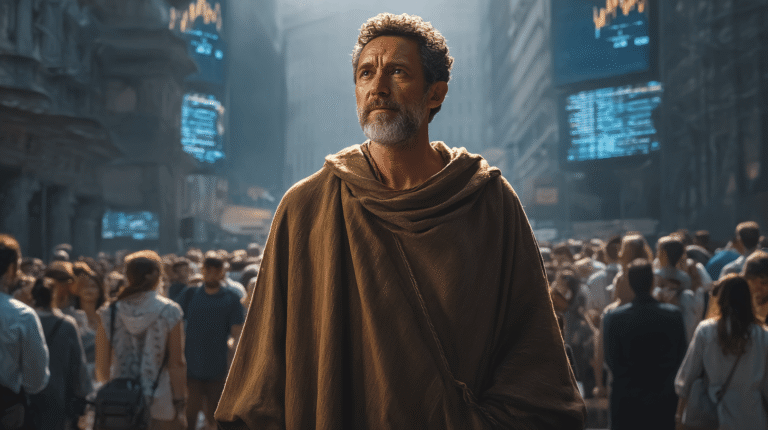
This structure resurfaces whenever people discuss how curated information environments shape belief. A social media feed, an algorithmically sorted news source, or a closed ideological community can function like the wall of shadows, offering a consistent and internally coherent picture of the world that nonetheless leaves out the mechanism producing it. The 1999 film The Matrix borrowed this exact structure so directly and deliberately that it has become one of the most common modern references for explaining Plato’s original idea to new audiences.
The deeper and more uncomfortable lesson of the allegory, though, is not just that illusions exist. It is that recognizing an illusion does not automatically make it welcome. The freed prisoner does not return to gratitude. He returns to ridicule, and in Plato’s telling, to real danger. Plato was not describing enlightenment as a reward. He was describing it as a burden that the enlightened person may be forced to carry back into a world that has no particular interest in hearing what he has to say.
That is the real weight behind the allegory of the cave. It is not a story about how easy it is to find the truth. It is a story about how difficult it can be to live with it once you do.