Why Goya Painted the Darkest Side of Human Nature
A Court Painter Who Once Flattered Power
For the first half of his career, Francisco Goya painted the world the Spanish elite wanted to see. He designed cheerful tapestry scenes of picnics, dances, and games for the royal factory. He painted the aristocracy in silk and lace, capturing them at their most composed and dignified. By his forties, he had become the official painter to the Spanish court, a position that came with wealth, status, and access to the most powerful people in Spain.
Nothing in this early work hints at what would come later. There are no monsters, no massacres, no old men devouring their children. There is only the polished, decorative style expected of a court artist working under an absolute monarchy.
So what happened? How did a painter of pleasant tapestry designs become the artist behind some of the most disturbing images in Western art—images of war crimes, madness, and mythological horror painted directly onto the walls of his own home? The answer is not a single event but a slow accumulation of illness, war, and disillusionment that changed both how Goya saw the world and what he believed art was for.
The Illness That Changed Everything
In 1792, while traveling in southern Spain, Goya fell seriously ill. He nearly died, and when he recovered, he was permanently deaf. Historians still debate the exact cause of the illness. Explanations proposed over the years have included lead poisoning from his paints, a viral infection affecting the inner ear and brain, and other rare disorders. No single diagnosis has been confirmed, and the medical record from over two centuries ago is simply too thin to settle the question.
What is certain is the effect. Deafness cut Goya off from ordinary conversation and forced him into a kind of internal exile even while he remained in the middle of Spanish public life. He could still see everything around him, but he could no longer easily participate in it. That isolation gave him more room to observe, and more reason to distrust the surface of things.
This is the period when his art begins to change. The decorative brightness of his tapestry cartoons gives way to sharper, more skeptical work. He starts drawing the people he sees not as they wished to be seen, but as he now perceived them: vain, foolish, cruel, or trapped by superstition.
Los Caprichos and the Monsters of Reason
In 1799, Goya published a set of eighty etchings called Los Caprichos. The series satirizes greed, superstition, clerical corruption, and the vanity of the aristocracy he had spent years painting flatteringly. One image, showing a man asleep at his desk while bats and owls swarm around him, carries an inscription that has become one of the most quoted lines in art history: reason, left unattended, produces monsters.
That idea captures something central to Goya’s mature outlook. He had absorbed the Enlightenment belief that reason and education could improve society. But he had also watched how easily people abandoned reason when fear, superstition, or self-interest took hold. Los Caprichos is not a rejection of Enlightenment values. It is a warning about how fragile those values are.
The etchings were bold enough that Goya withdrew them from sale after only a few days, likely wary of the Spanish Inquisition, which still had the power to punish work seen as heretical or subversive. The caution says as much as the etchings themselves: Goya understood that he was working close to a line that could still bring real consequences.
War Arrives, and Goya Watches
Whatever restraint Goya still had was tested by what came next. In 1808, Napoleon’s forces invaded Spain, triggering a brutal, years-long conflict known as the Peninsular War. Goya lived through the occupation and the resistance that followed, and what he saw left a permanent mark on his art.
Between roughly 1810 and 1820, Goya produced a series of eighty-two prints known as The Disasters of War. Unlike traditional battle paintings, which glorified generals and decisive victories, these images show summary executions, mutilated bodies, starvation, and the collapse of order on both sides of the conflict. There are no heroes in the series. There is only the record of what war does to ordinary people, rendered with an unflinching directness that had no real precedent in European art.
Goya did not publish The Disasters of War during his lifetime. The prints were considered too raw and too politically dangerous, and they were not released to the public until decades after his death. Their existence alone tells us something important: Goya kept working on his most brutal images even knowing they might never be seen. He was no longer painting for patrons or the market. He was recording what he believed needed to be recorded.
This same instinct shaped The Third of May 1808, one of his most famous paintings, completed in 1814. It depicts the execution of Spanish civilians by a French firing squad, painted with a rawness that abandoned the formal conventions used for historical battle scenes. A single man in a white shirt stands with his arms raised before the rifles, his face lit starkly against the darkness. The painting does not celebrate resistance. It shows terror, without dignity or spectacle, at the exact moment before death.
The Black Paintings: Art Made for No One
By the early 1820s, Goya was in his seventies, profoundly deaf, and living through one of the most repressive periods in modern Spanish history. King Ferdinand VII had returned to the throne and reversed the liberal reforms of the constitutional period, restoring absolute monarchy and reviving the Inquisition. Many of Goya’s liberal friends and allies were imprisoned, executed, or forced into exile. Goya himself withdrew to a house outside Madrid known as the Quinta del Sordo, or the House of the Deaf Man.
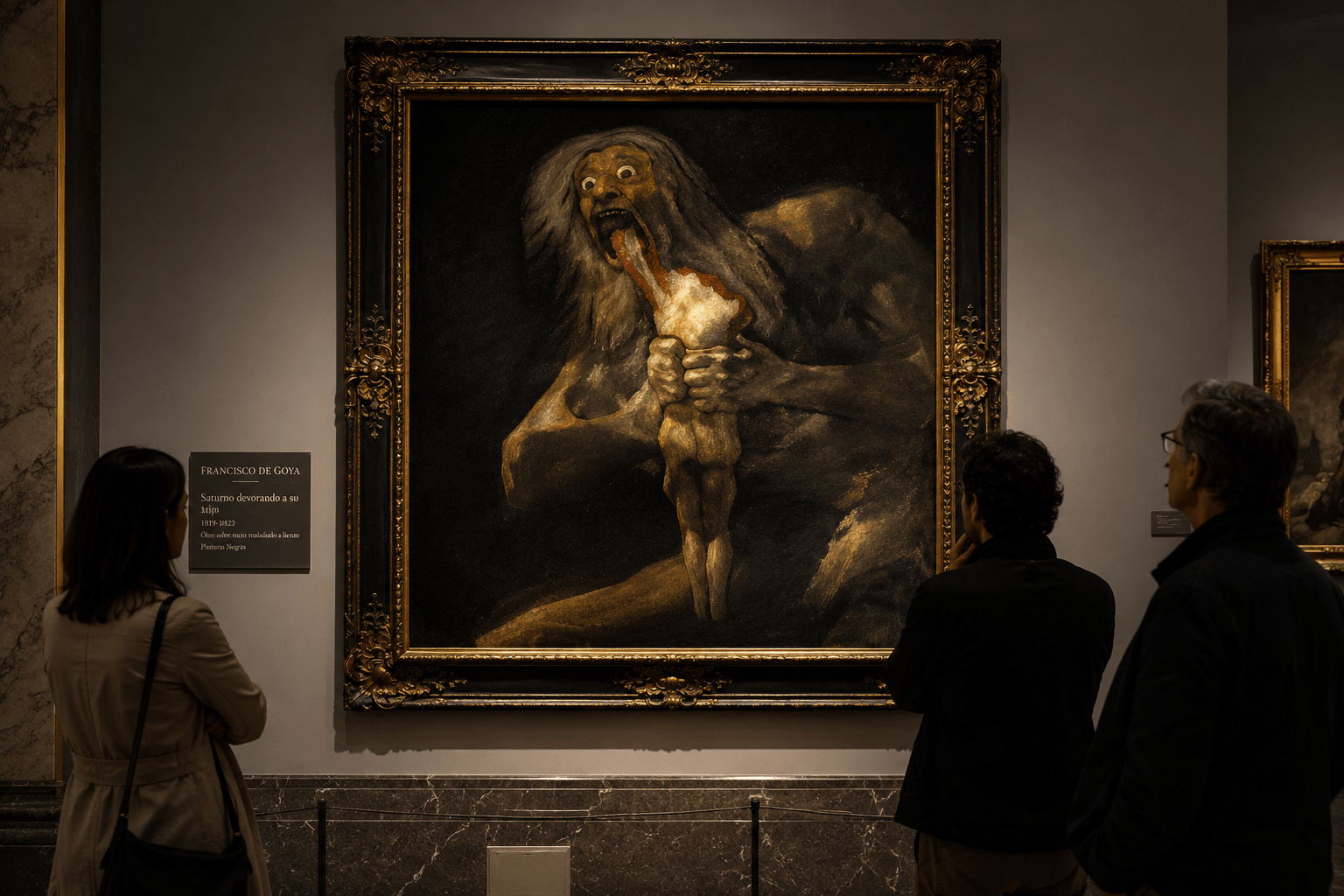
There, without any commission and apparently without any intention of showing the work to the public, Goya painted directly onto the plaster walls of his home. The result is a set of fourteen paintings now known as the Black Paintings, later removed from the walls and transferred to canvas for preservation. They include some of the most unsettling images in Western art: a witches’ sabbath, two men beating each other with clubs while sinking into mud, and Saturn Devouring His Son, which shows the god consuming the body of his own child in a state of wide-eyed panic.
Because Goya never explained these paintings and never intended them for exhibition, their meaning remains genuinely open to interpretation. Some art historians read them as a private reckoning with old age, illness, and the failure of the political ideals he had once supported. Others see them as a meditation on irrational violence more broadly, a subject Goya had already explored in Los Caprichos and The Disasters of War. What almost all serious scholarship agrees on is that these were not commissioned decorations meant to please a viewer. They were made for an audience of one.
What Popular Memory Gets Wrong
A common and appealing story about the Black Paintings holds that Goya was losing his mind when he made them, that the paintings are essentially a diary of madness brought on by illness and isolation. This narrative is dramatic, but most contemporary art historians treat it with caution.
The paintings show clear evidence of deliberate compositional choices, sophisticated technique, and thematic continuity with Goya’s earlier, more overtly political work. A person in the grip of genuine psychological collapse rarely produces work this controlled and this consistent with their prior artistic concerns. The likelier explanation is not that Goya had lost his grip on reality, but that he had lost his patience with pretending things were better than they were.
This distinction matters. Treating the Black Paintings as symptoms of madness lets viewers set them at a safe distance, as the product of a damaged mind rather than a clear-eyed verdict on the world Goya had actually witnessed. Reading them instead as a deliberate artistic statement is more disturbing, because it means an old, ill man who had seen war, repression, and betrayal up close chose to leave behind this vision of humanity as his final word.
Why This Still Matters
Goya’s late work occupies an unusual place in the history of art because it refuses to soften what it shows. Earlier depictions of war, myth, and cruelty in European painting generally preserved a sense of order, heroism, or moral clarity, even when the subject matter was violent. Goya’s mature work breaks with that tradition. His firing squads, his witches, his devouring gods offer no reassurance and no clear moral lesson. They simply insist that this, too, is part of being human.
That insistence is part of why his influence extends so far beyond his own century. Artists who wanted to depict atrocity, irrationality, or psychological extremity without prettifying it, from later war artists to twentieth-century Expressionists, found in Goya a precedent for taking the ugliest aspects of human behavior seriously as subject matter, rather than treating them as something art should look away from.
Goya did not paint humanity’s darkest moments because he had stopped believing in reason, justice, or human dignity. He painted them because he had watched those ideals fail in practice, repeatedly and at close range, and he refused to leave that failure undocumented. The court painter who once flattered kings ended his career leaving behind a private, unflinching record of what happens when reason loses its grip. That record has outlasted the political order it responded to, and it still unsettles viewers precisely because it refuses to look away.