Why The Moon and Sixpence Became the Novel Readers Turn to Before They Quit Everything
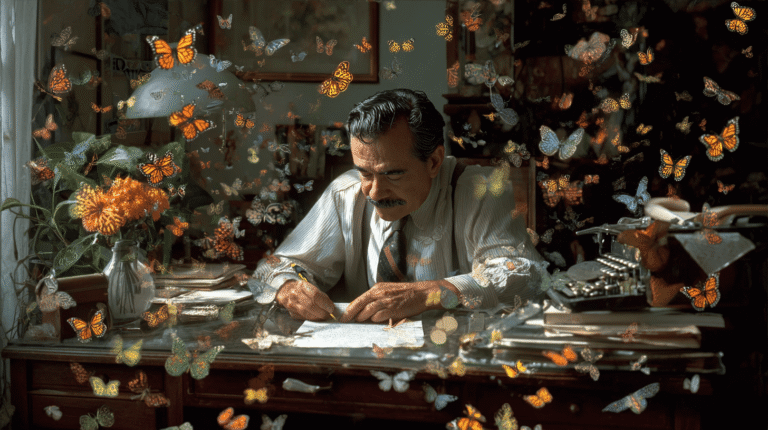
A middle-aged stockbroker with a comfortable London life disappears one day, leaving a note for his wife and no real explanation. He is not having an affair. He has not lost his mind, not exactly. He has simply decided, without warning, that he wants to paint.
That is the premise of W. Somerset Maugham’s 1919 novel The Moon and Sixpence, and it has unsettled readers for more than a century. The book keeps resurfacing in conversations about career changes, creative risk, and the itch to abandon a stable life for something less certain. People recommend it to friends who are thinking about quitting their jobs. They quote it, half-jokingly, when they daydream about starting over.
But the novel that keeps getting cited as an anthem for following your passion is, on close reading, something much less comfortable. Maugham did not write a hero. He wrote a man who destroys nearly everyone who loves him, and he built the entire book around the question of whether that destruction can ever be justified by what the man creates. Understanding why The Moon and Sixpence still grips readers means understanding that discomfort, not smoothing it over.
A Novelist Working in the Shadow of a Real Painter
Maugham was already a successful playwright and novelist by the time he wrote The Moon and Sixpence, and he was drawing, loosely, on a real artist’s life: Paul Gauguin, the French painter who had left a career in finance, then eventually his family, to pursue painting, and who spent his final years working in Tahiti before dying in French Polynesia in 1903.
Maugham had traveled to Tahiti and gathered secondhand accounts of Gauguin from people who had known him there. He was clear, however, that his protagonist, Charles Strickland, was not a biography. Strickland is English rather than French, a stockbroker rather than a stockbroker-turned-broker’s-assistant, and the specific events of his life diverge from Gauguin’s at almost every turn. What Maugham borrowed was the shape of the story: a conventional, financially secure man who walks away from his family in midlife to pursue painting, endures poverty and the contempt of respectable society, and eventually creates work that the world only learns to value after his death.
This distinction matters because it explains what kind of book Maugham set out to write. He was not trying to explain a specific historical figure. He was using a recognizable, semi-legendary artist’s life as raw material for a different question: what does genius actually cost, and who pays for it?
The Story Maugham Actually Tells
The novel is narrated by an unnamed writer who first meets Strickland’s wife at a London dinner party, in the years before Strickland leaves. She is a conventional literary hostess who enjoys having authors at her table. Her husband barely speaks and seems entirely unremarkable.
Then Strickland vanishes to Paris, and the narrator is drawn into the aftermath almost against his will, first by Strickland’s abandoned wife, who wants him found, and later by his own curiosity about what kind of man could do something so coldly deliberate.
What the narrator finds in Paris is not a romantic bohemian. Strickland is rude, indifferent to the suffering he causes, and largely uninterested in explaining himself. He is living in poverty by choice, painting obsessively, showing his work to almost no one, and treating the people who help him with something close to contempt. In one of the novel’s darkest turns, Strickland moves in with a friend and fellow painter who nurses him through a serious illness, and repays that kindness by beginning an affair with the friend’s wife, an affair that ends in her suicide. Strickland’s reaction to her death is detachment bordering on indifference.
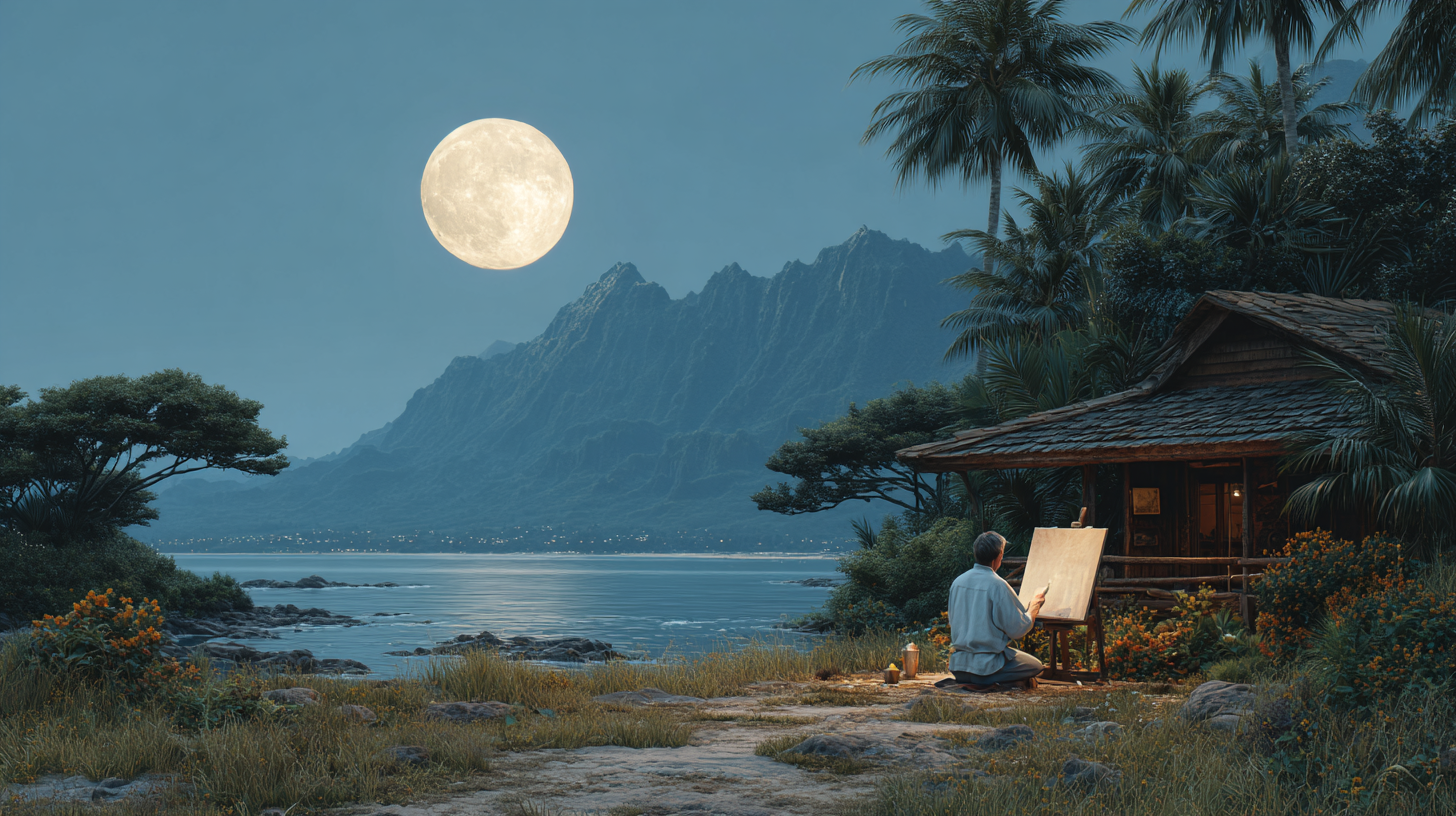
Eventually Strickland makes his way to Tahiti, where he lives with a young Tahitian woman, continues painting in near-total obscurity, contracts leprosy, and dies blind, having covered the walls of his final home with an enormous mural that he had ordered burned after his death, unseen by anyone but the people who nursed him in his final days.
By the time the novel ends, Strickland’s paintings are famous and enormously valuable. The narrator, reconstructing his life secondhand, is left holding an unresolved question rather than a moral.
The Tension Readers Keep Returning To
The Moon and Sixpence is often summarized as a story about an artist who sacrifices everything for his work, and left at that summary, it sounds like straightforward inspiration: leave the safe path, follow the calling, accept the cost. That is precisely the reading the novel keeps resisting.
Maugham does not let Strickland off easily, and he does not let the reader off easily either. The narrator repeatedly tries to understand Strickland through ordinary moral categories, cruelty, selfishness, genius, and finds that none of them quite fit. Strickland is not portrayed as secretly kind beneath the surface. He is portrayed as a man who has decided that painting matters more than any person, including himself, and who is willing to prove it.
This refusal to soften Strickland is what gives the book its staying power. A story about a misunderstood genius who turns out to be a good man underneath would be comforting and forgettable. A story about a genuinely difficult, often cruel man whose work turns out to matter enormously is much harder to dismiss, and much harder to fully endorse.
The novel’s real subject, then, is not “follow your passion.” It is the much less comfortable question of whether extraordinary creative achievement can ever justify ordinary human damage, and whether the people who ask that question honestly can ever answer it cleanly.
Where the Title Actually Comes From
The phrase “the moon and sixpence” never appears inside the novel itself, which surprises many readers who assume it is a line spoken by a character. According to an account that has circulated widely among Maugham’s biographers and critics, the title was inspired by a review of an earlier Maugham novel, Of Human Bondage, in which a critic described its protagonist as someone so preoccupied with reaching for the moon that he failed to notice the sixpence lying at his feet.
Maugham reportedly liked the image enough to build a new title around it, even though it had originally been written about a different book entirely. Read that way, the moon represents an unreachable, romantic ideal, artistic transcendence, in this case, while the sixpence represents the small, practical, attainable rewards of an ordinary life: a stable income, a comfortable home, the approval of respectable society.
Strickland chooses the moon without hesitation and without apparent regret. What the novel refuses to resolve is whether that choice makes him free or merely indifferent to everyone except himself.
Why the “Follow Your Passion” Reading Persists Anyway
Despite the novel’s genuine moral discomfort, it keeps getting adopted as a kind of permission slip. Part of the reason is structural: readers arrive already knowing, or quickly learning, that Strickland’s paintings become famous after his death. That foreknowledge colors everything that comes before it. Because the ending confirms that Strickland really was a genius, it becomes tempting to read backward and treat every cruelty along the way as the regrettable but necessary cost of that genius.
This is the same logic that surrounds real artists whose personal conduct was indefensible but whose work endured. Success retroactively recruits sympathy for the choices that preceded it. If Strickland’s paintings had been mediocre, the novel would read as a case study in a man’s selfishness and delusion. Because they turn out to be extraordinary, many readers unconsciously grant him a kind of exemption.
Maugham seems to have anticipated this. The narrator’s persistent unease, his refusal to fully condemn or fully admire Strickland, functions as a check against exactly this temptation. The novel does not ask readers to approve of Strickland. It asks them to sit with the fact that his life poses a genuine dilemma rather than a satisfying answer.
A Book People Reach for at a Particular Moment
The novel tends to resurface, generation after generation, whenever large numbers of people are quietly weighing a conventional, secure life against an uncertain, more personally meaningful one. It has been cited repeatedly in discussions of professionals leaving stable careers for creative or unconventional paths, and it remains a familiar reference point in conversations about risk, identity, and what people owe to the roles they have already built for themselves, whether as spouses, parents, or employees.
Part of its usefulness in these conversations is that it refuses to hand over a simple answer. A novel that said abandoning your obligations for your art is always right, or always wrong, would be far less useful to someone actually facing that decision. The Moon and Sixpence instead dramatizes the full weight of the choice: the specific people who get hurt, the specific years of poverty and failure that come before any recognition, and the very real possibility that recognition might never come at all.
Readers who are tempted to walk away from something stable do not, in the end, find reassurance in this book. What they find is a mirror that shows them exactly what the walking away would cost, stated plainly, without the comforting haze that usually surrounds stories about creative risk.
What the Novel Leaves the Reader With
The enduring power of The Moon and Sixpence lies not in the answer it gives but in the honesty of the question it refuses to close. Maugham was not interested in telling readers whether Strickland was right to abandon everything for his painting. He was interested in showing, in unflinching detail, what that abandonment actually looked like from the outside, to a wife, a friend, a lover, and a narrator who never quite manages to forgive or condemn the man at the center of the story.
That refusal to resolve the tension is precisely what keeps the novel useful to readers a century later. Anyone weighing a comfortable, sixpence-shaped life against the uncertain pull of something larger will find, in Strickland, neither a hero to imitate nor a villain to dismiss, but a warning about how completely a single obsession can consume a human life, genius included.
The moon does not care what it costs to be reached. Maugham’s achievement was refusing to pretend otherwise.
Frequently Asked Questions
Is The Moon and Sixpence based on a true story?
It is loosely inspired by the life of the painter Paul Gauguin, who left a career in finance to pursue art and later settled in Tahiti. Maugham changed the protagonist’s nationality, personal history, and many specific events, so the novel should be read as fiction inspired by a real artist rather than a factual biography.
Is Charles Strickland meant to be admired?
Maugham deliberately avoids presenting Strickland as either a straightforward hero or villain. He is shown as talented and utterly indifferent to the suffering he causes, and the novel resists offering a clear moral verdict on him.
Why is the book called The Moon and Sixpence if that phrase never appears in the text?
According to a widely repeated account among Maugham’s biographers, the title borrows an image from a review of his earlier novel Of Human Bondage, which described its protagonist as so fixed on reaching the moon that he missed the sixpence at his feet.
Does the novel end with Strickland’s paintings being discovered?
Yes. Strickland dies in relative obscurity in Tahiti, and his paintings only gain widespread recognition and value after his death, a detail that significantly shapes how readers interpret his earlier choices.