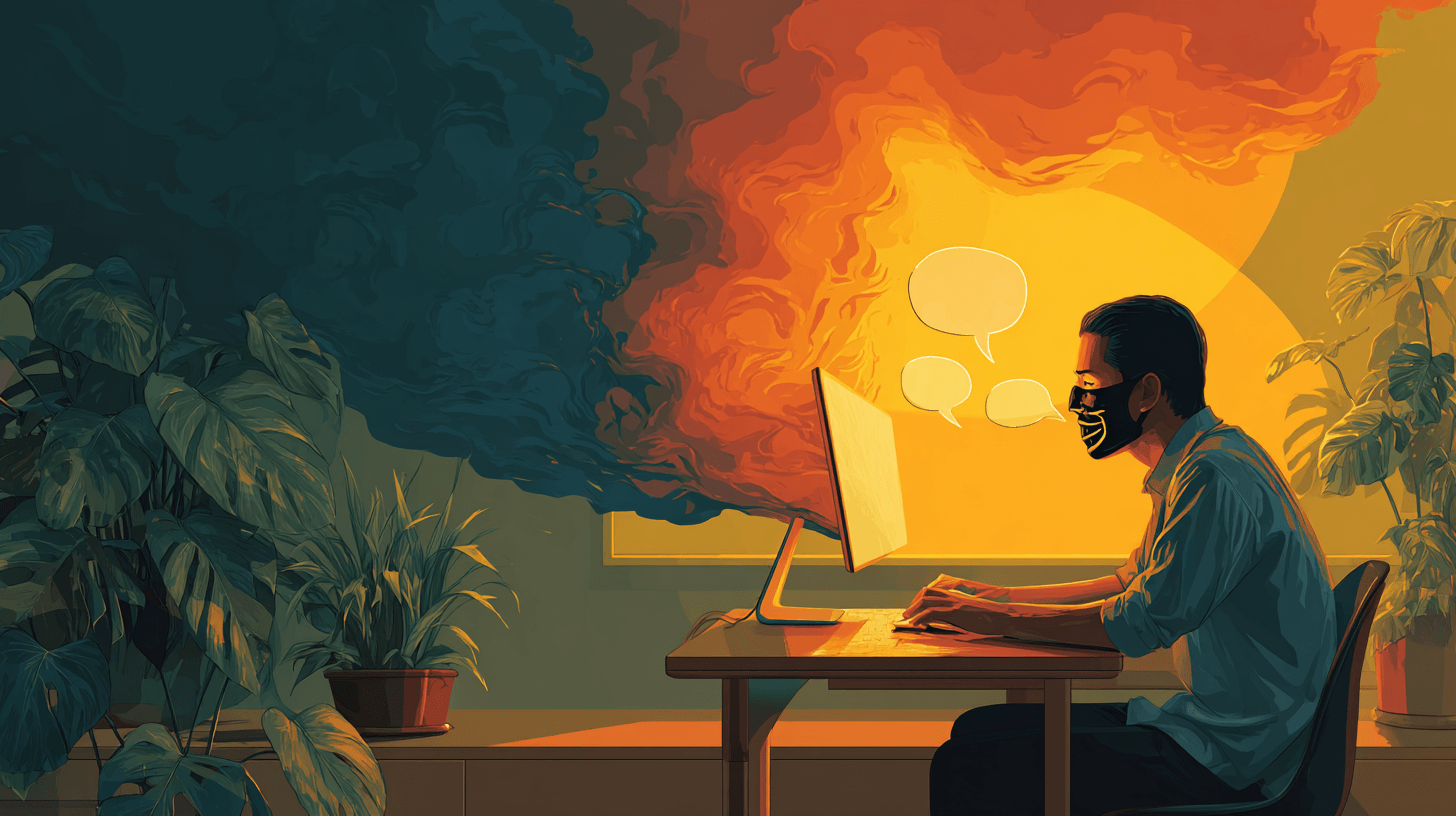
Why Anonymity Turns Ordinary People Cruel
A woman posts a photo of her new haircut. Within an hour, dozens of strangers have told her it’s hideous, that she looks old, that she should never post again. None of these commenters would say this to her face. Most of them are, by every account from people who know them, decent and unremarkable people.
This is the puzzle behind almost every toxic comment section, every pile-on, every anonymous message board thread that spirals into cruelty: the people typing the words are not, in any other context, cruel people. Something about the screen changes them. The central question is not whether anonymity makes people meaner — that much is obvious to anyone who has spent time online. The real question is what anonymity actually removes from a person’s mind that normally keeps cruelty in check.
Psychologists have been studying this question since long before the internet existed, using masks, costumes, and hooded robes instead of usernames. Their answer is more precise, and more unsettling, than “anonymity brings out your true self.”
What Anonymity Actually Takes Away
The dominant explanation in psychology is called deindividuation, a term introduced by social psychologist Philip Zimbardo in 1969. The idea is not that anonymity unlocks a hidden inner monster. It is that anonymity strips away two ordinary psychological brakes: self-awareness and accountability.
In face-to-face life, people constantly monitor themselves. They notice how others are reacting to them, and they know that their words and actions can be traced back to them personally. That combination — being watched and being identifiable — keeps most people’s behavior close to their own standards and to social norms.
Remove a person’s name, face, and reputation from the equation, and both brakes weaken at once. There is less private self-awareness, so people act on impulse rather than reflection. And there is less public accountability, so the normal fear of consequences fades. Zimbardo’s theory predicted that under these conditions, behavior would drift toward whatever was easiest, most impulsive, or most consistent with the immediate situation — not necessarily toward evil, but toward a loss of restraint.
That distinction matters. Deindividuation does not simply switch on cruelty. It switches off the internal editor that normally filters behavior before it happens.
The Costume Experiments
Zimbardo tested this idea directly. In one classic study, he had female participants deliver what they believed were electric shocks to another person, supposedly as part of a learning experiment. Some wore ordinary clothing and name tags. Others wore hoods that concealed their identity and were never referred to by name. The hooded, anonymous participants delivered longer shocks than the identifiable ones.
A later and in some ways more telling study came from psychologist Edward Diener and his colleagues in 1976, using an unlikely laboratory: Halloween. Diener’s team set up houses where trick-or-treating children were told to take only one piece of candy each, then left alone with a bowl. Some children arrived in costumes that concealed their identity; others were not disguised. Children in groups and in costume were considerably more likely to take extra candy than children who were alone or unmasked. Anonymity alone raised the odds of rule-breaking, and anonymity combined with group presence raised it further.
A third study, by Robert Johnson and Leslie Downing in 1979, added a twist that turned out to be crucial. They repeated a version of the shock experiment, but varied what the anonymous costume looked like. Participants dressed in Ku Klux Klan–style robes delivered more shocks than a control group. But participants dressed as nurses delivered fewer shocks than the control group, even though they were equally anonymous.
The costume itself was steering behavior. Anonymity was not producing cruelty in general — it was amplifying whatever behavior the immediate situation or symbol suggested.
Six Doors to Losing Restraint
When psychologist John Suler examined online behavior in a widely cited 2004 paper, he found that internet anonymity rarely worked alone. He identified several factors that combine to loosen a person’s normal restraint online, a pattern he called the online disinhibition effect.
Beyond anonymity itself, Suler pointed to invisibility — the fact that online, people cannot see the hurt expression or shaking hands of the person they are addressing, which strips away the emotional feedback that normally makes cruelty uncomfortable to continue. He pointed to the delay between sending a message and receiving a reaction, which lets people fire off something harsh and log off before facing any response. And he pointed to what he called solipsistic introjection: the tendency to read a stranger’s words in your own internal voice, which can make an online exchange feel more like an argument inside your own head than an encounter with a real person.
Each of these factors removes a small piece of what normally makes a real, face-to-face conversation feel consequential. Stack several of them together, and a fairly ordinary person can end up saying things they would never say out loud.
It Is Not Simply About Losing Control
For a while, deindividuation was described almost like a psychological blackout — anonymity supposedly dissolved the individual into an unthinking crowd. Later research complicated that picture considerably.
Psychologists Tom Postmes and Russell Spears, reviewing dozens of deindividuation studies in the late 1990s, found that anonymous or deindividuated people were not simply becoming more impulsive across the board. Their behavior was shifting to match whatever group norm or situational cue was most salient at the time. This became known as the social identity model of deindividuation effects, or SIDE.
Under this model, anonymity does not erase a person’s identity. It shifts which identity is in charge. Stripped of individual accountability, people tend to fall back on group identity instead — and they start acting according to the norms of whatever group or crowd they perceive themselves to be part of. This is precisely why the Johnson and Downing costume study came out the way it did. The KKK-style robe cued a norm of hostility. The nurse’s uniform cued a norm of care. Anonymity did not create cruelty out of nothing; it made people more responsive to the cues around them, for better or worse.
Online, this helps explain why anonymous forums built around outrage tend to escalate quickly, while anonymous forums built around support or hobbyist enthusiasm often stay remarkably civil. The anonymity is identical. The prevailing norm is not.
The Kindness Nobody Talks About
Because online cruelty is so visible, it is easy to assume anonymity is inherently corrosive. But Suler’s own framework included what he called benign disinhibition: people sharing personal struggles, offering support to strangers, or being unusually generous specifically because no one would know who they were.
Anonymous mental health forums, peer support communities, and confession-style accounts often depend on exactly the same psychological mechanism that fuels harassment elsewhere. Remove the fear of judgment and reputational cost, and some people become crueler. Others become more honest, more vulnerable, and more willing to help a stranger they will never meet.
Anonymity does not reveal who a person really is. It reveals what a person does when the cost of being seen disappears — and that turns out to depend heavily on what the group around them expects.
What This Means for the Platforms We Use
This research has shaped a real and ongoing debate among platform designers, researchers, and policymakers: does forcing people to use their real names actually reduce toxic behavior?
The evidence is more mixed than intuition suggests. Real-name policies do increase accountability, and some studies link them to modest reductions in hostile comments. But they do not eliminate the underlying dynamics that Suler and the SIDE researchers described. Invisibility, delayed feedback, and group norms operate even when a username is attached to a real name. A person can be fully identifiable and still feel psychologically distant from the person they are arguing with. Meanwhile, real-name requirements carry their own costs, particularly for people who rely on anonymity for legitimate safety reasons — domestic abuse survivors, whistleblowers, LGBTQ+ users in hostile environments, and political dissidents among them.
The more consistent finding across the research is that visible group norms matter as much as identity does. Platforms and communities that actively signal what kind of behavior is expected — through moderation, community tone, and early example-setting — shape behavior even under full anonymity. Communities that tolerate or reward hostility will get more of it, regardless of whether usernames are real names or not.
The Real Lesson of the Mask
The costume experiments, the Halloween candy bowls, and decades of online research point to the same underlying truth: cruelty behind anonymity is not a mask coming off. It is a different set of social rules stepping in to fill the space the mask leaves behind.
Most people are not secretly cruel, waiting for an opportunity to remove their identity and reveal it. What anonymity removes is the immediate cost of unkindness — the visible hurt, the traceable reputation, the individual accountability that normally keeps behavior tethered to a person’s own values. What fills that gap is whatever norm is loudest in the moment.
That is a less comfortable explanation than “the internet brings out people’s true selves,” but it is also a more useful one. It suggests that cruelty online is not an unfixable fact of human nature finally let loose. It is a predictable response to a specific set of missing signals — and a response that shifts, often dramatically, depending on what kind of room the mask happens to walk into.
Frequently Asked Questions
Does anonymity always make people behave worse?
No. Research consistently shows anonymity amplifies whatever behavior a situation or group norm already encourages. In hostile or unmoderated spaces, that often means more aggression. In supportive communities, the same anonymity can encourage more honesty and generosity.
Is deindividuation the same as losing self-control entirely?
Not quite. Early theories described it that way, but later research, particularly the social identity model of deindividuation effects, found that anonymous people are not out of control so much as more responsive to group norms and situational cues than usual.
Do real-name policies solve online harassment?
Not on their own. Real names increase accountability but do not remove other factors like invisibility, delayed feedback, and group dynamics. Some research links real-name requirements to modestly less hostility, but they also create real safety risks for vulnerable users.
Why do some anonymous communities stay kind while others turn toxic?
The difference usually comes down to established norms. Communities that model and reinforce respectful behavior tend to sustain it even under full anonymity, while communities that tolerate hostility tend to see it escalate.