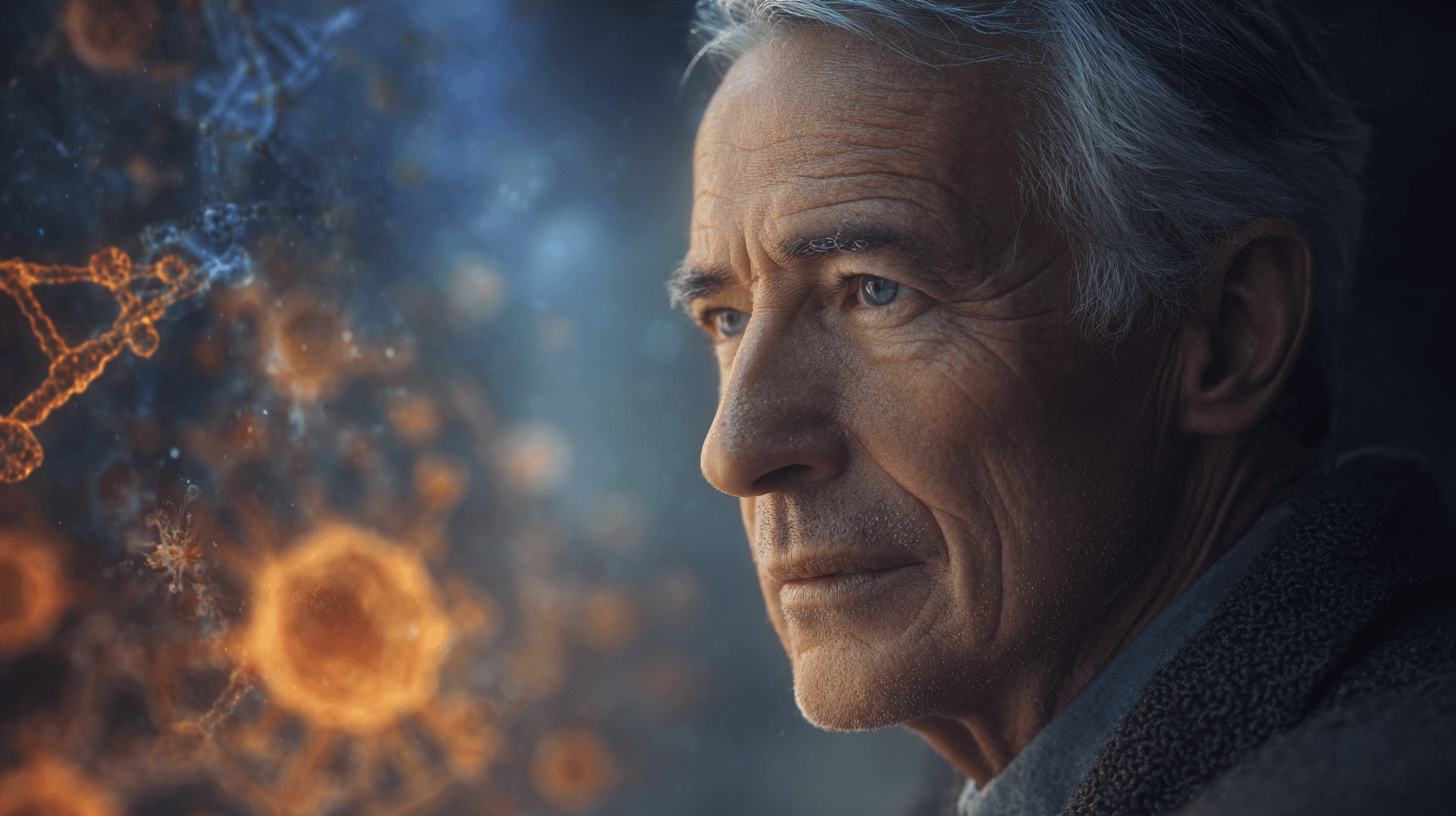
Why Do Humans Age? The Cellular Damage the Body Can No Longer Outrun
Every second, your body replaces roughly two million red blood cells. Over a lifetime, your skin regenerates itself dozens of times over, your gut lining rebuilds itself every few days, and your liver can regrow tissue after significant damage. If the body is this good at repairing and replacing itself, a strange question follows: why does it eventually fail anyway?
This is the central puzzle of aging biology. It is not that the body simply “wears out” the way a machine does, because unlike a machine, the body is constantly rebuilding its own parts. Something else is happening — a slow accumulation of damage that repair systems can manage for decades but never fully eliminate.
Understanding why humans age means looking past the visible signs — gray hair, slower joints, wrinkled skin — and into the cellular machinery where the real process unfolds. It turns out aging is not one single thing. It is the combined result of several interacting biological processes, each identified through decades of research and now grouped by scientists into a shared framework known as the hallmarks of aging.
A Question Evolution Never Fully Answered
Natural selection is extremely good at solving survival problems, so it is worth asking why it never eliminated aging. The answer lies less in physiology than in evolutionary logic.
Natural selection is strongest early in life, when an organism is reproducing and passing on genes. Its influence weakens with age, because genetic mutations that cause harm late in life — after reproduction has already occurred — face very little selective pressure to be removed from a population. Biologist George Williams called this antagonistic pleiotropy: some genes that provide a benefit in youth, such as boosting fertility or strengthening the immune system early on, can have damaging effects decades later. Natural selection favors the early benefit and effectively ignores the later cost.
A related idea, the disposable soma theory proposed by biologist Thomas Kirkwood, suggests that organisms face a biological trade-off between investing energy in reproduction and investing energy in long-term cellular maintenance. Since resources are limited, an organism that spends more energy repairing and protecting its cells has less energy for reproduction, and vice versa. Evolution tends to favor whichever balance produces the most surviving offspring, not the balance that produces the longest individual life.
In other words, the body was never built for indefinite maintenance. It was built to function well enough, for long enough, to reproduce and raise offspring. Everything beyond that point runs on a maintenance system that was never optimized to last forever.
The Damage That Never Fully Gets Fixed
At the molecular level, aging begins with damage to DNA. Cells are exposed to a constant stream of stress — ultraviolet light, metabolic byproducts, chemical exposure, and simple copying errors during cell division. The body has extensive repair systems for this damage, but they are not perfect. Over decades, small, uncorrected errors accumulate in the genome, a process researchers call genomic instability.
This accumulated damage does more than introduce random mutations. It also disrupts epigenetic regulation — the system of chemical tags that tells each cell which genes to switch on or off. A skin cell and a neuron contain the same DNA; what makes them different is which genes are active. As epigenetic control becomes less precise with age, cells can begin behaving less like their specialized selves, a shift researchers have linked to age-related decline in tissue function.
One additional layer of genomic wear involves the ends of chromosomes, called telomeres. Each time a cell divides, its telomeres shorten slightly, acting as a kind of biological countdown. When telomeres become too short, the cell typically stops dividing altogether. This does not simply remove old cells from circulation — it often leaves them behind in a strange, semi-active state.
When Cells Refuse to Die
Instead of dying quietly when they can no longer divide, many damaged or aged cells enter a state called cellular senescence. A senescent cell stops replicating, but it does not disappear. It lingers in tissue, releasing a cocktail of inflammatory signaling molecules known as the senescence-associated secretory phenotype, or SASP.
In small numbers, senescent cells are useful. They help suppress the growth of potentially cancerous cells and assist in wound healing. The trouble comes with accumulation. As more senescent cells build up in aging tissue, their inflammatory signals spread outward, disrupting nearby healthy cells and contributing to chronic, low-grade inflammation throughout the body — a condition researchers now call inflammaging.
This is a clear example of how aging is not caused by decline alone. It is also caused by defense mechanisms that become harmful once they persist too long. The immune system’s own response to injury, useful in a young, healthy body, becomes a slow source of damage when it never fully switches off.
The Power Plants Running Down
Nearly every cell in the body depends on mitochondria, the structures that convert nutrients into usable energy. Mitochondria carry their own small set of DNA, separate from the DNA in the cell nucleus, and this mitochondrial DNA is especially vulnerable to damage because it sits close to the byproducts of energy production itself.
For decades, scientists attributed much of aging to reactive oxygen species — unstable molecules generated during energy production that can damage nearby proteins and DNA. This became known as the free radical theory of aging. More recent research has complicated that picture considerably. Reactive oxygen species are not simply harmful waste; at moderate levels, they function as signaling molecules that help cells adapt to stress, a process called mitohormesis. Aging appears to involve not the mere presence of these molecules, but a breakdown in the systems that regulate them and clear out malfunctioning mitochondria.
As mitochondrial efficiency drops with age, cells throughout the body — particularly in energy-hungry tissues like muscle, heart, and brain — produce less usable energy and accumulate more cellular waste. The result is a body that has to work harder to do what once came easily.
A System That Slowly Stops Communicating
Aging is not confined to individual cells. It also changes how tissues, organs, and systems interact with each other.
Stem cells, which are responsible for replacing damaged or worn-out tissue, gradually lose their regenerative capacity with age. Bone marrow stem cells that once readily produced new blood and immune cells become less active. Muscle stem cells that once repaired injury respond more slowly. This decline, called stem cell exhaustion, means the body becomes progressively less able to replace what it loses.
At the same time, the signals that cells use to coordinate with one another become less reliable. Hormonal balance shifts, immune signaling becomes chronically activated rather than responding only to genuine threats, and even the trillions of bacteria living in the gut — collectively known as the microbiome — tend to become less diverse, a change researchers now include among the recognized drivers of aging under the term dysbiosis.
None of these processes operates in isolation. Damaged DNA promotes cellular senescence. Senescent cells drive inflammation. Inflammation impairs stem cell function. Impaired stem cells reduce the body’s ability to repair the very damage that started the cycle. Aging is not a single failing system — it is a network of systems degrading together, each one making the others harder to manage.
What Popular Beliefs Get Wrong About Aging
Much of the public conversation about aging still centers on outdated or oversimplified ideas. One persistent misconception is that aging has a single cause waiting to be discovered — a master switch that, once flipped, would stop the clock. Modern research points in the opposite direction: aging results from multiple interacting mechanisms, and addressing only one, such as reducing oxidative stress with antioxidant supplements, has not been shown to meaningfully extend human lifespan.
Another common misunderstanding treats aging as a strictly linear countdown, ticking at the same rate for everyone. In reality, biological age and chronological age frequently diverge. Two people of the same calendar age can have meaningfully different levels of cellular damage, inflammation, and tissue function, shaped by genetics, environment, and lifestyle. Researchers increasingly measure this gap using biomarkers of biological aging rather than relying on birth year alone.
A third misconception assumes that “anti-aging” science means preventing death indefinitely. Most current research in the field, often called geroscience, is not aimed at radical life extension. It is aimed at compressing the period of illness and disability that tends to accompany old age — extending healthspan, the years lived in good functional health, rather than simply extending lifespan itself.
Why the Question Still Matters
Understanding aging as an interconnected biological process, rather than a single mysterious decline, has practical consequences. Nearly every major chronic disease of later life — heart disease, many cancers, type 2 diabetes, Alzheimer’s disease — shares underlying biological risk factors with the aging process itself. If chronic inflammation, cellular senescence, and mitochondrial dysfunction contribute broadly to age-related disease, then interventions targeting those shared mechanisms could, in principle, address multiple conditions at once rather than treating each disease separately after it appears.
This is part of why aging research has shifted so heavily toward the hallmarks framework in the past decade. Instead of asking “how do we cure heart disease” and “how do we cure Alzheimer’s” as separate questions, researchers are increasingly asking what shared cellular processes make the body vulnerable to both — and whether slowing those shared processes could delay the onset of many age-related conditions simultaneously.
The body was never built to run forever. But understanding exactly where and why its maintenance systems eventually fall behind has turned aging from an unavoidable mystery into a set of specific, researchable biological problems — some of which may, within limits, be possible to slow down.
Aging does not happen because the body simply stops trying to repair itself. It happens because repair was never designed to keep pace with damage indefinitely — and by the time that gap becomes visible, it has usually been widening for decades.
Frequently Asked Questions
Is aging classified as a disease?
Not officially in most countries, though this is debated among researchers. Aging is currently treated as a risk factor for disease rather than a disease itself, though some scientists argue that classifying it as a treatable condition could accelerate research funding and drug development.
Can the aging process be reversed?
Some individual hallmarks of aging, such as certain markers of cellular senescence, have been reduced experimentally in animal studies using specific compounds or genetic techniques. However, no intervention has been shown to reverse human aging as a whole, and claims of “reversing aging” in humans should be treated with caution.
Why do some animals age much more slowly than humans?
Species such as the naked mole rat and certain deep-sea clams show remarkably slow aging or unusually effective damage-repair systems. Comparative biologists study these species specifically because they may reveal alternative evolutionary solutions to the trade-offs that shape aging in most animals, including humans.
Does everyone age at the same rate?
No. Genetics, environment, chronic stress, diet, and disease history all influence how quickly cellular damage accumulates. This is why researchers distinguish between chronological age and biological age, which can differ substantially between two people born in the same year.