What Plato’s Theory of Forms Actually Claims About Reality
Picture two things: a circle drawn quickly in the sand with a stick, and the perfect geometric circle you learned about in a math class, the one where every point is exactly equidistant from the center. No one has ever seen that second circle. No one ever will. Every circle drawn, poured, or built is slightly off, smudged by the imprecision of physical material. Yet somehow, everyone understands what a perfect circle is, and everyone can judge the sand drawing as a flawed attempt at it.
This gap between the imperfect things we encounter and the precise concepts we use to judge them puzzled Plato more than almost anything else. Why do people recognize beauty in a face, justice in an action, or equality between two lengths of rope, when no single physical example is ever quite complete? His answer became one of the most influential and controversial ideas in the history of philosophy: the Theory of Forms.
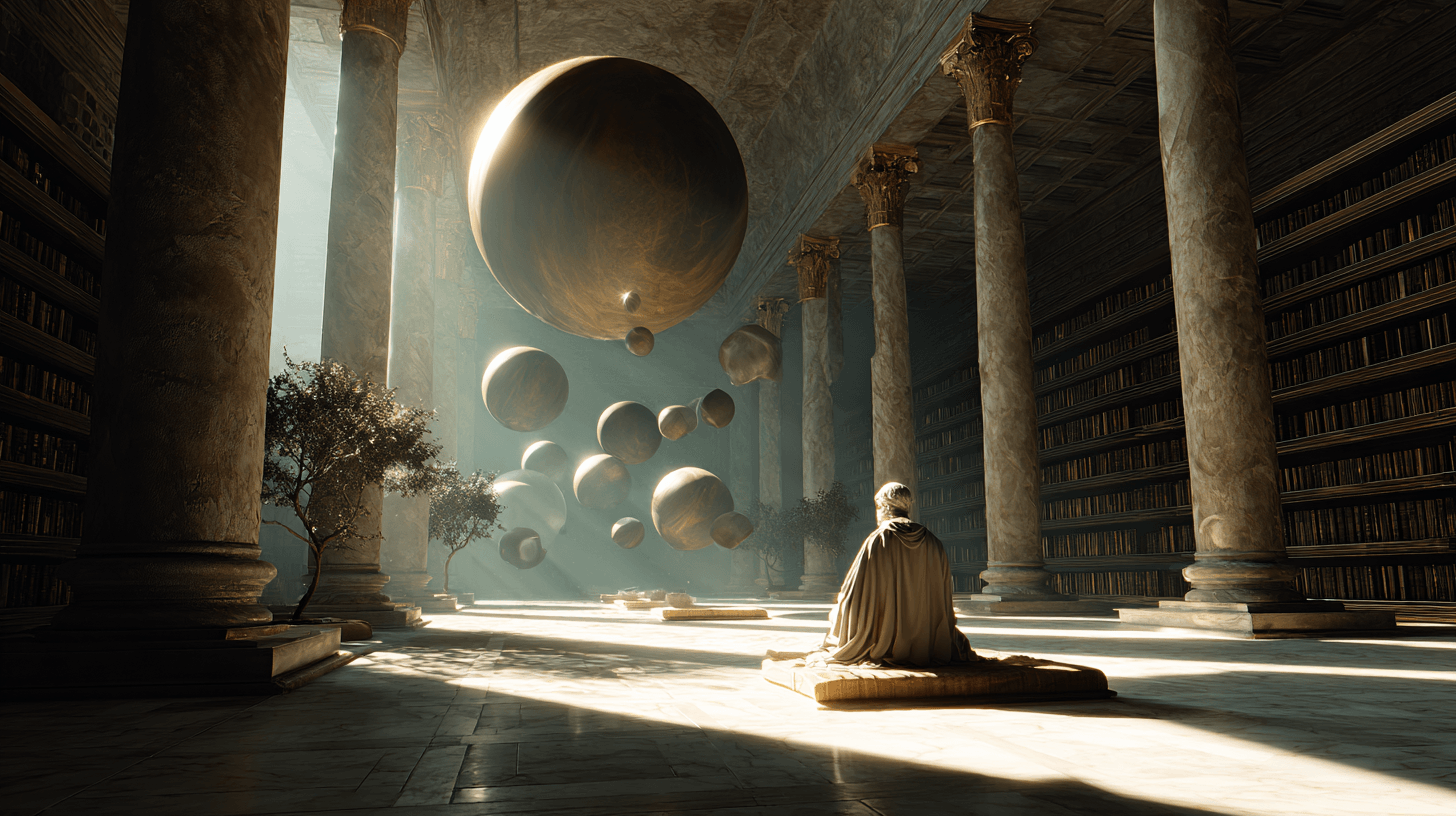
The theory claims that behind the changing, imperfect world we perceive with our senses lies a separate realm of perfect, unchanging realities. These are the Forms. Ordinary objects are not fully real in themselves; they are more like shadows or copies, imitating something more stable and more true. Understanding why Plato reached this striking conclusion, and why it has never stopped generating debate, reveals something fundamental about how humans try to make sense of a world that never holds still.
The Problem Plato Inherited
Plato did not invent his central question. He inherited it from two philosophers who had already pulled Greek thought in opposite directions.
Heraclitus argued that everything is in constant flux. Rivers change from moment to moment, and so does everything else; nothing stays the same long enough to be truly known. Parmenides argued almost the opposite: that true reality must be permanent and unchanging, because change itself is logically incoherent. If something is always becoming something else, in what sense does it ever really exist?
Plato inherited both problems at once. He accepted, largely from Heraclitus, that the physical world genuinely is unstable. Bodies age, weather shifts, political systems rise and collapse, and even our own opinions change from year to year. But he also accepted, from Parmenides, that genuine knowledge requires a stable object. You cannot have reliable knowledge of something that never stops changing, because by the time you have understood it, it is already different.
This left Plato with an uncomfortable question. If the physical world is constantly shifting, and knowledge requires something fixed, then how is real knowledge possible at all? His answer was to split reality in two.
Two Levels of Reality
Plato proposed that there are two distinct levels of existence. One is the world of appearances, sometimes called the sensible world, which includes everything we perceive through sight, touch, hearing, and the other senses. This is the world of individual chairs, particular acts of courage, specific triangles drawn on paper, and the endless variety of living things. Every item in this world is subject to change, decay, and imperfection.
The other level is the world of Forms, sometimes translated as Ideas, from the Greek word eidos. The Forms are not physical objects and cannot be perceived with the senses. They are grasped only through reason. Each Form represents the perfect, unchanging essence of a category: Beauty itself, Justice itself, Equality itself, and, in Plato’s view, even mathematical objects like Circularity itself.
According to Plato, particular things in the physical world are called beautiful, just, or equal only because they participate in, or imitate, the corresponding Form. A beautiful painting is beautiful because it partakes of Beauty itself, not the reverse. The Form is the source; the physical object is a derivative copy, always falling short of the original.
This is the central move of the theory. Ordinary objects are not simply less impressive versions of the Forms. Plato argues they are less real, precisely because they change, decay, and vary, while the Forms remain permanently and perfectly what they are.
The Allegory of the Cave
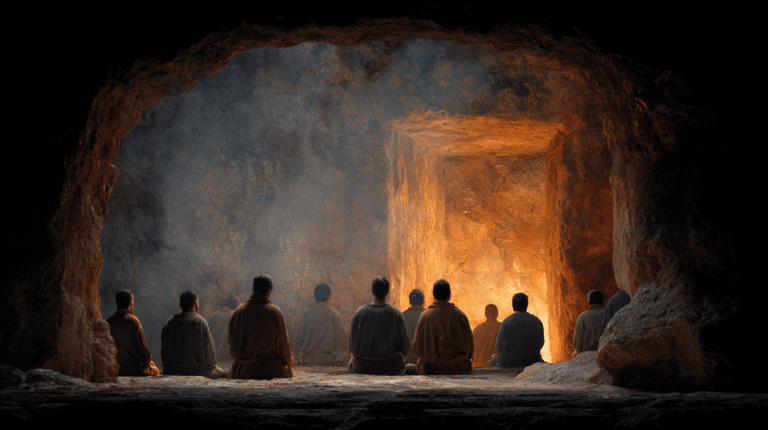
Plato’s most famous illustration of this divide appears in the Republic, in what is known as the Allegory of the Cave. Prisoners are chained inside a cave from birth, facing a blank wall. Behind them burns a fire, and between the fire and the prisoners, people carry objects whose shadows fall on the wall. Because the prisoners have never seen anything else, they mistake the shadows for the whole of reality.
One prisoner is freed and dragged out of the cave. At first the sunlight is blinding, and the ascent is described as painful and disorienting rather than instantly clarifying. Gradually, his eyes adjust. He sees the objects that had only ever cast shadows before, and eventually he can look at the sun itself, which Plato uses as a symbol for the Form of the Good, the highest Form, the source of truth and value for everything else.
The allegory is not simply about ignorance versus knowledge. It is Plato’s account of an entire process: what it costs to move from mistaking appearances for reality toward direct rational understanding of the Forms. The freed prisoner who returns to the cave to explain what he has seen is met with confusion and hostility, since the other prisoners, comfortable with the shadows, have no framework for what he describes. Many readers have connected this scene to the trial and execution of Socrates, Plato’s teacher, who was condemned by Athenian citizens for the kind of relentless questioning that the cave allegory dramatizes.
Why Plato Thought Reason, Not the Senses, Reveals Truth
The Allegory of the Cave reflects a broader argument that runs through Plato’s dialogues: the senses are unreliable guides to what is truly real, while reason can access something the senses cannot.
Plato pointed to mathematics as evidence. A geometry student can reason with total confidence about a perfect triangle, one whose angles sum to exactly 180 degrees, even though no physical triangle ever drawn meets that standard precisely. If our knowledge of triangles came only from observing physical shapes, it would be approximate and uncertain. Instead, mathematical knowledge feels exact and necessary. Plato concluded that this precision could only come from the mind’s access to a perfect, non-physical triangle, the Form of Triangle, which physical drawings merely approximate.
In dialogues such as the Meno, Plato extends this reasoning into psychology through the theory of recollection. He has Socrates guide an uneducated slave boy toward solving a geometry problem purely through questioning, without directly teaching him the answer. Plato uses this scene to argue that the boy is not learning something entirely new, but recollecting knowledge the soul possessed before birth, from direct contact with the Forms. Whether or not this specific argument persuades modern readers, it reveals Plato’s underlying conviction: some forms of knowledge feel too certain, too universal, and too independent of any particular sensory experience to have been derived from the senses alone.
The Form of the Good
Among the Forms, Plato treats one as uniquely important: the Form of the Good. In the Republic, he compares it to the sun. Just as the sun makes physical objects visible and also causes their growth, the Form of the Good makes the other Forms intelligible and gives them their value and purpose.
This is not a moral rule in the ordinary sense, like a specific commandment about how to act. It functions more like an ultimate standard against which all other Forms, and by extension every particular thing that participates in them, can be measured and understood. Justice, courage, and beauty are valuable, in Plato’s framework, because they are structured by and oriented toward the Good. Understanding the Good is presented as the highest achievement of philosophical education, requiring years of training in mathematics and dialectic before a person is ready to grasp it.
Objections Plato Himself Raised
Remarkably, one of the sharpest challenges to the Theory of Forms comes not from a critic but from Plato himself. In the dialogue Parmenides, an older Parmenides interrogates a young Socrates about the theory, and the exchange exposes serious difficulties that Plato never fully resolved in his later work.
One problem, later formalized as the Third Man Argument, points to a regress. If a beautiful object is beautiful by resembling the Form of Beauty, and the resemblance itself is a kind of similarity, then explaining that similarity might require another, higher Form that both the object and the Form of Beauty resemble. If a new Form is needed to explain each act of resemblance, the explanation never actually terminates.
A second problem concerns participation itself. Plato never fully specifies the mechanism by which a physical object shares in a Form that exists on an entirely separate level of reality. Saying that things “participate” in the Forms describes the relationship in a picturesque way, but it does not explain, in a rigorous sense, how a nonphysical, unchanging Form can causally shape a physical, changing object.
Aristotle, Plato’s student, pressed related objections from a different angle. He argued that Plato had needlessly doubled the world, positing a separate realm of Forms when the essential natures of things could instead be understood as embedded within the particular objects themselves. For Aristotle, the “form” of a horse was not a distant, perfect Horse existing in another realm, but the organizing structure and function present in every actual horse. This disagreement between teacher and student became one of the defining fault lines in the entire history of Western philosophy.
What Popular Summaries Often Miss
Simplified accounts of the Theory of Forms sometimes present it as a static, finished system, as though Plato announced it once and never revisited it. The dialogues themselves tell a more complicated story. The Parmenides shows Plato subjecting his own theory to serious internal criticism. Later dialogues, including the Sophist and Timaeus, modify and complicate the framework further, introducing new distinctions about how Forms relate to one another and to the physical world.
It is also a common misunderstanding to treat the Forms as though Plato considered them to be located somewhere, in the way a distant planet is located somewhere. The Forms are not spatial entities waiting in a hidden dimension. They are best understood as objects of pure rational understanding, accessible through logical and mathematical reasoning rather than through travel or sensory discovery of any kind.
Why the Theory Still Matters
The Theory of Forms shaped debates that extended far beyond ancient Athens. Centuries later, Neoplatonist philosophers such as Plotinus built elaborate metaphysical systems around a hierarchy of reality descending from a single ultimate source, drawing directly on Plato’s distinction between a perfect, unchanging origin and its imperfect worldly expressions. Early Christian theologians, most notably Augustine, adapted this structure to describe the relationship between God and creation, treating divine ideas as something like eternal Forms existing in the mind of God.
The theory’s influence persists today in a less obviously religious form, within the philosophy of mathematics. Some mathematicians and philosophers, often called mathematical Platonists, argue that numbers and geometric structures are not human inventions but genuine, mind-independent entities that mathematicians discover rather than create. When a working mathematician says a proof reveals something that was true all along, whether or not anyone had thought of it yet, that intuition echoes Plato’s original conviction that some truths exist independently of the changing, physical world.
The broader philosophical debate over universals, the question of whether general categories like redness, humanity, or justice exist independently of the particular things that instantiate them, remains active in academic philosophy. Contemporary philosophers disagree sharply on this question, and the debate has evolved considerably since antiquity, but the terms of the disagreement still trace back to the challenge Plato first posed: how can changing, particular things be meaningfully grouped under stable, general concepts?
The Question That Outlasted the Answer
Plato’s Theory of Forms was never universally accepted, not even by his own most brilliant student. Its account of participation remains philosophically unresolved, and its two-tiered picture of reality strikes many modern readers as metaphysically extravagant. Yet the question that generated the theory has proven far more durable than any particular answer to it.
Every time someone judges an imperfect example against an ideal standard, whether in mathematics, ethics, or aesthetics, they are engaging with the same puzzle that occupied Plato nearly twenty-five centuries ago. He did not simply propose a theory about hidden entities in an invisible realm. He identified a genuine tension between the world we experience and the concepts we use to make sense of it, a tension that philosophy has never fully dissolved, only continued to explore in new terms.
Frequently Asked Questions
Did Plato believe the Forms were real physical places?
No. The Forms are not physical or spatial. Plato treated them as objects of rational understanding, accessible through reasoning and dialectic rather than through sensory perception or travel to another location.
What is the difference between a Form and a concept in someone’s mind?
Plato considered the Forms to exist independently of any individual mind. A concept in a person’s head can be mistaken, incomplete, or forgotten, but for Plato, a Form such as Justice itself exists as a perfect, stable reality regardless of whether any particular person understands it correctly.
Did Aristotle completely reject the Theory of Forms?
Aristotle rejected the idea that Forms exist in a separate realm from particular things, but he retained the idea that objects have essential natures or forms. For Aristotle, this form was located within the object itself rather than in a distinct realm, a significant departure from Plato’s original position.
Is the Theory of Forms still taken seriously by philosophers today?
Aspects of it remain influential, particularly in debates over mathematical Platonism and the philosophical problem of universals. Few contemporary philosophers accept the theory in its original form, but the underlying questions it raised continue to shape ongoing philosophical discussion.