How Bronze Forged the First Connected World
The Bronze Age did not begin with a war, a king, or an empire. It began with a mixture. Somewhere in the highlands of Anatolia or the Caucasus, more than five thousand years ago, metalworkers discovered that adding a small amount of tin to molten copper produced something neither metal could achieve alone: a substance harder than copper, easier to cast, and capable of holding a sharp edge. That discovery seems modest. Its consequences were not.
Bronze required two metals that almost never occur in the same place. Copper was reasonably common across the eastern Mediterranean and Near East, but usable tin deposits were scarce and often thousands of kilometers away. For societies to make bronze at all, they had to reach far beyond their own borders and stay in contact with strangers they would never meet in person. That single technical constraint pushed early states, cities, and trading communities into a web of dependency that had never existed at that scale before.
This is the real question behind the Bronze Age: not simply what bronze was, but why a metal alloy reorganized how humans organized themselves. The answer runs through trade, power, writing, and war, and it ends with a warning still relevant today: interconnected systems can also be fragile ones.
A Metal That Could Not Be Made Locally
Archaeological and geochemical evidence places the earliest deliberate alloying of copper and tin in the mid-fourth millennium BCE, with the technology spreading from the Caucasus and Anatolia into Mesopotamia, the Aegean, and eventually the Indus Valley. Sumerian metalworkers were producing tin-bronze in Mesopotamia by roughly 3500 BCE.
The problem was geological, not technical. Once societies wanted bronze in quantity, they needed tin, and tin ore is rare in the regions where the earliest bronze-using civilizations arose. Some tin came from Anatolian mines such as Kestel, worked for centuries. Other supplies traveled extraordinary distances: recent isotopic analysis of Late Bronze Age shipwreck cargo has traced tin used in eastern Mediterranean bronze all the way back to Cornwall and Devon in southwestern Britain, nearly 4,000 kilometers away. Other research points to tin moving west from Central Asia, through the Zeravshan Valley in modern Tajikistan and the Hindu Kush, carried in stages by generations of traders who likely never knew where the metal had originally come from.
This is the detail that makes the Bronze Age genuinely new. Earlier Neolithic communities had traded valuable items across distances too, but bronze made large-scale, sustained, cross-continental supply chains a basic requirement of political and military power. A palace that wanted weapons and prestige goods could not simply mine what it needed at home. It had to plug into a network that stretched past the horizon of its own knowledge.
Trade Networks That Outgrew Any Single Ruler
By around 3200 BCE, tin was moving from Anatolia to Cyprus, where it was combined with locally mined copper and shipped onward across the eastern Mediterranean. Over the following centuries this pattern hardened into something resembling an international economy. Merchant communities specialized in moving metal, timber, textiles, and luxury goods between Egypt, the Levant, Anatolia, Mesopotamia, Cyprus, and the Aegean world of Mycenae and Knossos.
Nothing about this system depended on a single dominant power. Multiple kingdoms, palace economies, and independent trading cities participated simultaneously, exchanging not just goods but diplomatic letters, marriage alliances, and administrative practices. Tens of tons of tin are estimated to have moved through this network annually, supporting hundreds of tons of copper in circulation, enough to arm and equip entire kingdoms.
The consequence was a form of interdependence that had not existed before at this geographic scale. A disruption in a distant tin-producing region, a war blocking a trade route, or the collapse of a shipping network in one corner of the Mediterranean could ripple through economies that had never had direct contact with the original cause. Bronze Age societies had, in effect, built the first version of a truly international supply chain, and with it, the first version of the vulnerabilities that come with one.
Why Bronze Concentrated Power Instead of Spreading It
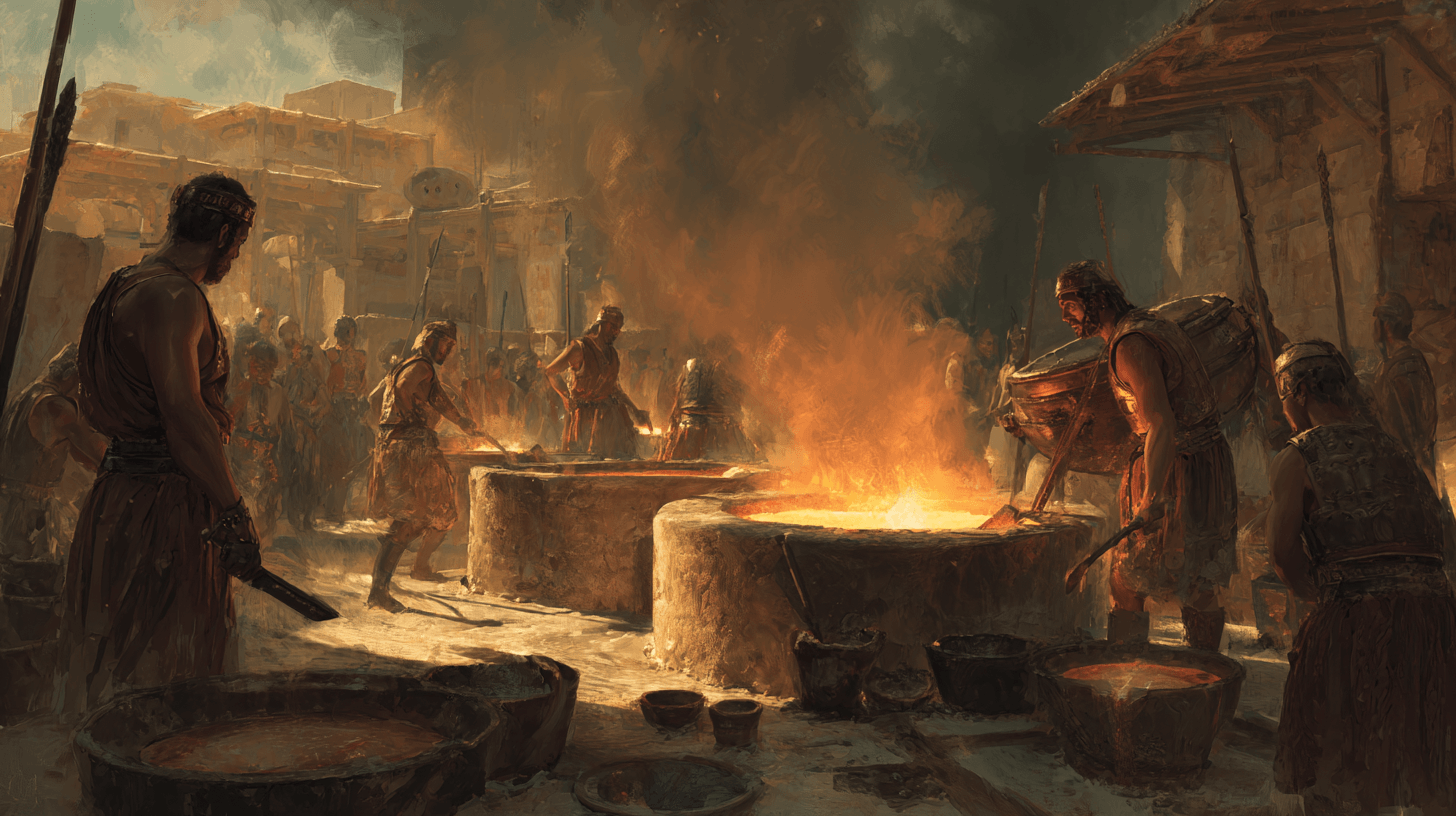
Unlike stone tools, which almost anyone could make from locally available material, bronze production required controlled access to imported ore, skilled smiths, fuel for smelting, and the organizational capacity to coordinate all of it. That combination favored people who already held authority.
Rulers and temple administrations that could organize trade expeditions, store metal reserves, and employ specialist craftsmen gained a durable advantage over communities that could not. Bronze weapons, armor, and prestige objects became instruments of status as much as tools of survival, reinforcing the position of elites who controlled the supply chain. This is one of the clearest ways bronze reshaped society: it did not simply arm existing hierarchies, it helped create them. Access to a resource that could not be produced locally became a mechanism for consolidating political power, a pattern that would recur with other scarce, high-value materials throughout later history.
This does not mean bronze single-handedly caused the rise of kings and states. Social stratification and urban administration were already developing in Mesopotamia before large-scale bronze production took hold, and historians continue to debate exactly how much weight to place on metal control versus other factors like irrigation, grain surplus, and population growth. What the evidence does support is that bronze reinforced and accelerated a shift toward centralized, hierarchical societies that was already underway, giving those in power a new and durable tool for maintaining it.
Warfare Became More Organized, Not Simply More Violent
Bronze changed how wars were fought by changing who could afford to fight them well. Bronze swords, spearheads, and armor offered real advantages over stone or unalloyed copper equivalents, but producing them at scale required exactly the kind of centralized resources that only established states and palace economies could muster.
The result was a shift toward standing armies, chariot forces, and fortified cities rather than loosely organized raiding bands. Major Late Bronze Age powers, including Egypt, the Hittite Empire, and Mycenaean Greece, invested heavily in bronze-equipped chariotry and infantry, and warfare between them took on a more institutionalized character, complete with treaties, alliances, and diplomatic correspondence recorded on clay tablets. The famous peace treaty between Egypt’s Ramesses II and the Hittite king Hattusili III, following decades of conflict, is one of the earliest surviving examples of formal international diplomacy, and it exists in the archaeological record partly because bronze-dependent kingdoms needed stable relationships to keep their supply chains functioning.
Writing Grew Out of the Same Need to Keep Track
The administrative demands of managing long-distance trade, palace storerooms, and metal allocation were closely tied to one of the era’s other transformative developments: writing. Cuneiform script in Mesopotamia and, later, Linear B in the Mycenaean world were used extensively for exactly the kind of record-keeping that a bronze economy required, tracking shipments, rationing metal to workshops, and recording tribute and taxation.
Writing was not invented solely to manage bronze, and its origins trace back to earlier accounting systems using clay tokens. But the scale and complexity of Bronze Age trade and administration gave writing systems a practical, expanding role they had not had before, embedding literacy and bureaucracy more deeply into how states functioned. A society running an international metal economy needed a way to remember commitments across years and across cultures that oral tradition alone could not reliably provide.
The Collapse That Revealed the System’s Fragility
Around 1200 BCE, within the span of a few decades, most of the major Late Bronze Age powers in the eastern Mediterranean experienced severe disruption or outright collapse. Mycenaean palaces were destroyed, the Hittite Empire disintegrated, Egyptian power contracted sharply, and numerous coastal cities across the region were abandoned or destroyed.
Historians and archaeologists continue to debate the precise causes, and no single explanation commands universal agreement. Proposed factors include prolonged drought and crop failure, earthquake damage documented at multiple sites, internal uprisings against strained palace economies, and the movement of groups Egyptian records call the “Sea Peoples,” whose exact identity and origin remain uncertain. What many researchers now emphasize is that these pressures likely compounded one another: a system built on tightly interlinked trade routes, specialized palace economies, and long supply chains for essential materials like tin had little redundancy built in. When several disruptions arrived close together, the same interdependence that had made Bronze Age civilization so productive also made it unusually vulnerable to cascading failure.
This is often what popular memory gets wrong about the Bronze Age collapse. It is frequently imagined as a single dramatic invasion sweeping across the Mediterranean. The more supported picture is a slower unraveling of an interconnected system that could not absorb multiple simultaneous shocks, a pattern of systemic fragility rather than a single conquering force.
What the Bronze Age Actually Changed
The significance of the Bronze Age was never really about the metal itself. It lay in what producing that metal forced human societies to build: sustained international trade networks, administrative writing systems capable of tracking complex economies, more centralized and militarized states, and early forms of formal diplomacy between rival powers. Bronze did not create civilization from nothing, but it gave existing trends toward hierarchy, urbanization, and long-distance exchange a powerful and durable engine.
The Bronze Age also left behind a lesson that later interconnected systems, from Roman grain supply lines to modern global shipping, would relearn in their own way. Interdependence can generate extraordinary prosperity and complexity, but it also concentrates risk. A network robust enough to move tin four thousand kilometers to arm a palace guard was also fragile enough to fracture when several of its supporting pillars gave way at once. Humanity’s first truly international economy did not fail because the idea was wrong. It failed because no one had yet learned how to build resilience into a system that had grown too interconnected to fail quietly.