Why Salvador Dalí Painted Clocks That Melt
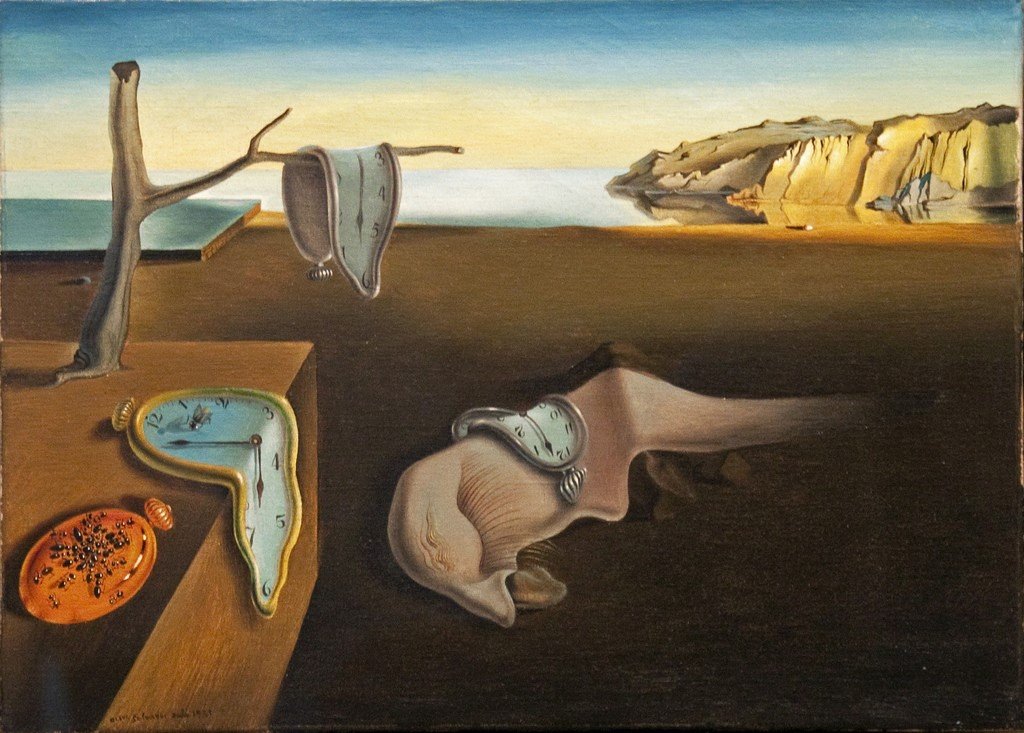
Something in Dalí’s tiny 1931 canvas refuses to sit still in memory. A barren coastline, a strange fleshy shape sleeping in the sand, and three pocket watches drooping over branches and ledges like wax left too close to a flame. The painting measures barely ten inches by thirteen, smaller than a sheet of notebook paper, yet it has become one of the most reproduced images in modern art.
The central puzzle is not hard to name. Why would an artist take the most rigid, mechanical object of the industrial age — the watch, the very instrument built to enforce precision — and render it soft, sagging, defeated by heat? Dalí’s own explanation, when he gave one, involved a piece of cheese left out in the sun. That anecdote is real, but it is only the surface of a much deeper decision about how to paint the unconscious mind.
The Persistence of Memory belongs to a moment when European artists were trying to solve a specific problem: how do you paint a dream? Dalí’s answer to that problem changed what people expect a strange image to look like, and it is worth understanding exactly how he got there.
The World Dalí Was Painting In
By 1931, Surrealism was roughly six years old as an organized movement, built on André Breton’s conviction that the unconscious mind, not conscious reason, held the deepest truths about human experience. Its members had spent the 1920s experimenting with automatic writing, chance encounters, and dream transcription, all in search of a way to bypass rational control and let the subconscious speak directly.
Dalí joined the group in 1929, arriving in Paris from Catalonia with a formal academic training that most of his new colleagues lacked. He could paint with photographic precision, which gave him an advantage the other Surrealists didn’t have: he could render impossible things with such convincing detail that viewers momentarily believed them.
Sigmund Freud’s theories of dreams, repression, and the unconscious were essential background for this entire generation of artists, and Dalí read them closely. He didn’t merely illustrate Freudian ideas; he tried to build a working method out of them, one that would let him access his own subconscious on command rather than waiting for dreams or chance.
The Method Behind the Melting
That method had a name: the paranoiac-critical method. Dalí described it as a way of deliberately inducing a hallucinatory or paranoid state of mind, then applying rigorous, almost clinical control to translate what he saw into a finished image. The irony was intentional. He wanted the wildest content produced through the most disciplined technique.
The Persistence of Memory is often cited as the clearest early demonstration of this method in action. According to Dalí’s later account, he had been working on a landscape of the Catalan coast near Port Lligat, where he and his partner Gala lived, when he sat down alone one evening in front of a round of Camembert cheese that had softened in the warm air. He described noticing the cheese and sitting for a long time absorbed in thought before it, later telling Gala that he had painted one of the most important pictures of his life. Quiet Canvas
Art historians treat this story with some caution. Dalí’s own accounts of his working process were famously theatrical, and this particular version is likely embellished. What seems more solidly established is the outcome: the watches in the finished painting look like soft cheese, and by Dalí’s own repeated account they were inspired by the sight of Camembert melting in the sun. Quiet CanvasEncyclopedia Britannica
Dalí leaned into the connection rather than downplaying it. He described his limp watches as picturing what he called “the camembert of time,” insisting that once the concept of time had lost all meaning, the watches’ softness followed naturally. In one often-quoted line, he called them “the soft, extravagant, solitary, paranoiac-critical Camembert cheese of space and time,” adding that whether the watches were hard or soft made no difference, as long as they still told time accurately. MoMADali Paintings
That last detail matters. Dalí wasn’t simply being whimsical. He was making a point: a soft watch that still, absurdly, keeps time is a better symbol of psychological time than a broken one, because it shows the mind bending reality without destroying its logic entirely. Dreams distort familiar things; they rarely erase them.
What the Melting Clocks Actually Represent
The most common interpretation, and the one supported by the strongest scholarly consensus, is that the watches dramatize the difference between mechanical time and subjective time. Clock time is uniform, external, and indifferent to human experience. The time we actually live through — in memory, in dream, in grief, in boredom — stretches, collapses, and refuses to behave.
The art historian Dawn Ades has argued that the painting expresses the relativity of time and space and the collapse of any fixed cosmic order. This reading places the painting in conversation with a wider cultural moment: Einstein’s theory of relativity, published only a few decades earlier, had already unsettled the idea that time moves at one fixed, universal rate. Dalí was not illustrating physics directly, but he was working in a cultural atmosphere where the certainty of clock time had already been shaken by science before he ever picked up a brush. Montview
The other objects in the painting reinforce this theme of decay and impermanence. Ants gathered on one of the watches represent decay, drawing on Dalí’s well-documented lifelong fear of insects. A single fly perches on another clock, and even the ants’ hourglass-shaped bodies echo the painting’s obsession with the passage of time. Nothing in the scene is decorative; each element restates the same argument from a different angle. Encyclopedia BritannicaDali Paintings
Then there is the strange, fleshy form lying in the center of the canvas, half-buried in the barren landscape, with a single closed eye, long eyelashes, and what looks like a curling mustache emerging from an otherwise skull-like shape. This distorted face is widely interpreted as a self-portrait, consistent with Dalí’s history of unconventional self-depictions in other works from the same period. If the watches represent the collapse of external time, the sleeping figure represents the mind experiencing that collapse from the inside, dreaming its way through a landscape it can no longer fully control. Dali Paintings
A Real Place Made Unreal
Unlike much Surrealist painting, which favored invented or generic settings, Dalí grounded this dreamscape in an actual location. The coastline is the seashore of northernmost Catalonia at Cape Creus, a landscape Dalí returned to throughout his career, complete with a recognizable landmark casting its long shadow across the beach. This was not a nostalgic backdrop; it was the immediate, everyday landscape where Dalí lived and worked for decades, from 1930 into the late 1980s. Encyclopedia BritannicaQuiet Canvas
That choice sharpens the painting’s disorientation rather than softening it. A wholly invented dreamscape would let a viewer keep the picture at arm’s length, filed away as pure fantasy. Grounding the scene in a specific, real coastline does the opposite: it plants one foot in recognizable reality while the other foot sinks into something that should be impossible. The technique Dalí used to paint that coastline only deepens the effect. He worked with what he called “the most imperialist fury of precision,” painting with the exacting clarity of an eye-fooling illusionist, in service of what he described as an ambition to systematize confusion and discredit the ordinary world of appearances. MoMA
That combination — meticulous, almost photographic technique applied to openly irrational content — is the real technical achievement of the painting. Dalí is not painting a symbol of a melting clock the way a cartoonist might, with loose, gestural lines suggesting softness. He paints every fold and drape of the melted metal with the same crisp precision a still-life painter might use for a bowl of fruit. The realism of the brushwork is what makes the unreality of the content so unsettling. A viewer’s eye is told, convincingly, that this is simply how the world looks, even as their mind insists that it cannot be.
From Studio Curiosity to Cultural Icon
The painting’s rise to fame was not instantaneous, but it was fast by the standards of twentieth-century art. It was completed in 1931 and shown at Surrealist exhibitions in the years that followed, and by the end of the decade it had entered the collection of the Museum of Modern Art in New York, where it remains one of the museum’s most visited works. Its size surprises almost everyone who sees it in person for the first time; reproductions in books and on posters give no sense of just how small and intimate the original canvas is.
Its longevity has as much to do with legibility as with mystery. Unlike many Surrealist works, which require some familiarity with dream theory or private symbolism to unpack, The Persistence of Memory communicates its central idea almost instantly. Anyone who has ever felt time drag during a difficult afternoon or vanish during a joyful one already understands, intuitively, what a melting clock is trying to say. The painting does not explain or describe the experience of dreaming so much as it reproduces the visual logic of a dream directly — familiar objects thrown into unfamiliar states, hard things gone soft, all rendered with disorienting clarity. Quiet Canvas
That accessibility explains its enormous afterlife in popular culture. The image has been referenced in television shows including The Simpsons and Sesame Street, each borrowing its central visual joke — objects that shouldn’t melt, melting anyway — for their own purposes. Few twentieth-century paintings have made that leap from museum wall to shared cultural shorthand so completely. Artsy
What People Get Wrong About the Painting
The most persistent misunderstanding is that the melting clocks are meant to represent some specific, calculable relationship to Einstein’s physics, as though Dalí had set out to illustrate a scientific theorem. That reading overstates the connection. Dalí was absorbing a cultural mood in which the fixed, absolute nature of time had already been called into question by science, but the painting is a psychological statement first, built from Freud and the artist’s own method of induced hallucination, not a literal diagram of relativity.
A second misconception treats the cheese story as a cute footnote, unrelated to the painting’s deeper meaning. In fact, the anecdote captures the entire logic of the paranoiac-critical method in miniature: an ordinary domestic object, observed with unusual intensity, triggers an association that Dalí then renders with total technical control. Whether the story happened exactly as Dalí told it or not, it demonstrates precisely how his method was supposed to work — hallucination first, precision second.
Why the Image Still Holds
The Persistence of Memory endures because it captures a tension every person recognizes without needing to study Surrealism to understand it: the gap between the clock on the wall and the time we actually feel passing through us. Dalí found a way to paint that gap directly, using a piece of household cheese as his unlikely starting point and a coastline he knew by heart as his stage.
What makes the painting more than a clever visual trick is its restraint. Dalí resisted the urge to overload the canvas with symbols; a barren beach, three clocks, a scattering of ants, and one dreaming face carry the entire argument. Each element does real work, and nothing is there simply to look strange.
Nearly a century later, the watches still haven’t finished melting, and that may be the point. A clock that stopped would only mark one broken moment. A clock that keeps dissolving, slowly and endlessly, is a better picture of how memory actually behaves — never quite fixed, never quite finished, always a little soft at the edges.