How America Won a War It Was Supposed to Lose
The Colonies Had No Business Winning
In 1775, Britain possessed the most powerful navy on Earth, a professional army with decades of combat experience, and a treasury that could fund campaigns across multiple continents. The thirteen colonies had none of these things. They had no national army, no navy worth mentioning, no central treasury, and no functioning government beyond a loose congress with no legal authority to tax or command.
By any conventional measure, the American Revolution should have ended quickly and badly for the rebels. Yet eight years later, Britain signed a treaty recognizing the independence of the United States. The question worth asking is not simply what happened during the war, but how a fractured coalition of farmers, merchants, and part-time soldiers managed to outlast an empire.
The answer has little to do with any single battle or any single hero. It has everything to do with geography, endurance, foreign intervention, and a British strategy that was undermined by the very scale of the empire it was trying to protect.
Distance Was America’s First Weapon
Britain’s core problem was never courage or firepower. It was distance. Every soldier, every musket ball, and every barrel of salted beef had to cross three thousand miles of ocean, a journey that typically took six to eight weeks each way.
This meant that orders from London were often outdated by the time they reached commanders in America. A general might receive instructions based on conditions that no longer existed, forcing him to choose between obeying stale orders or improvising with incomplete authority. Reinforcements that seemed urgent in London might arrive months after the crisis that prompted them had already passed.
The scale of the American theater compounded the problem. The colonies stretched along nearly 1,300 miles of coastline, with population centers separated by forests, rivers, and poor roads. Britain could capture almost any city it wanted. It captured New York, Philadelphia, and Charleston at different points in the war. But occupying a city was not the same as controlling a countryside, and the countryside is where the war was actually decided.
A War Britain Could Not Afford to Fight Alone
Britain was not merely fighting the American colonies. It was managing a global empire with commitments in India, the Caribbean, and continental Europe, all while trying to suppress a rebellion an ocean away.
This mattered enormously once France entered the war in 1778, followed by Spain and the Dutch Republic. Suddenly Britain faced the prospect of French fleets threatening its Caribbean sugar islands, French invasion fears at home, and a naval balance that no longer guaranteed British supremacy in American waters.
Historians often treat the alliance with France as a moral victory for the American cause, a recognition of shared republican ideals. The reality was colder and more strategic. France’s foreign minister, the Comte de Vergennes, supported the American rebellion primarily because a weakened Britain served French interests after France’s humiliating defeat in the Seven Years’ War. Benjamin Franklin, serving as America’s representative in Paris, understood this calculation and used it skillfully, framing American resistance as an opportunity for France rather than a cause deserving charity.
The consequences were significant. French money, weapons, and eventually French soldiers and warships gave the Continental Army resources it could never have generated on its own. At Yorktown in 1781, the battle that effectively ended major fighting, French naval forces under Admiral de Grasse blocked the Chesapeake Bay and prevented British reinforcement or evacuation by sea. Washington’s army provided the land force, but the naval blockade made the trap inescapable.
Washington’s Strategy Was Survival, Not Conquest
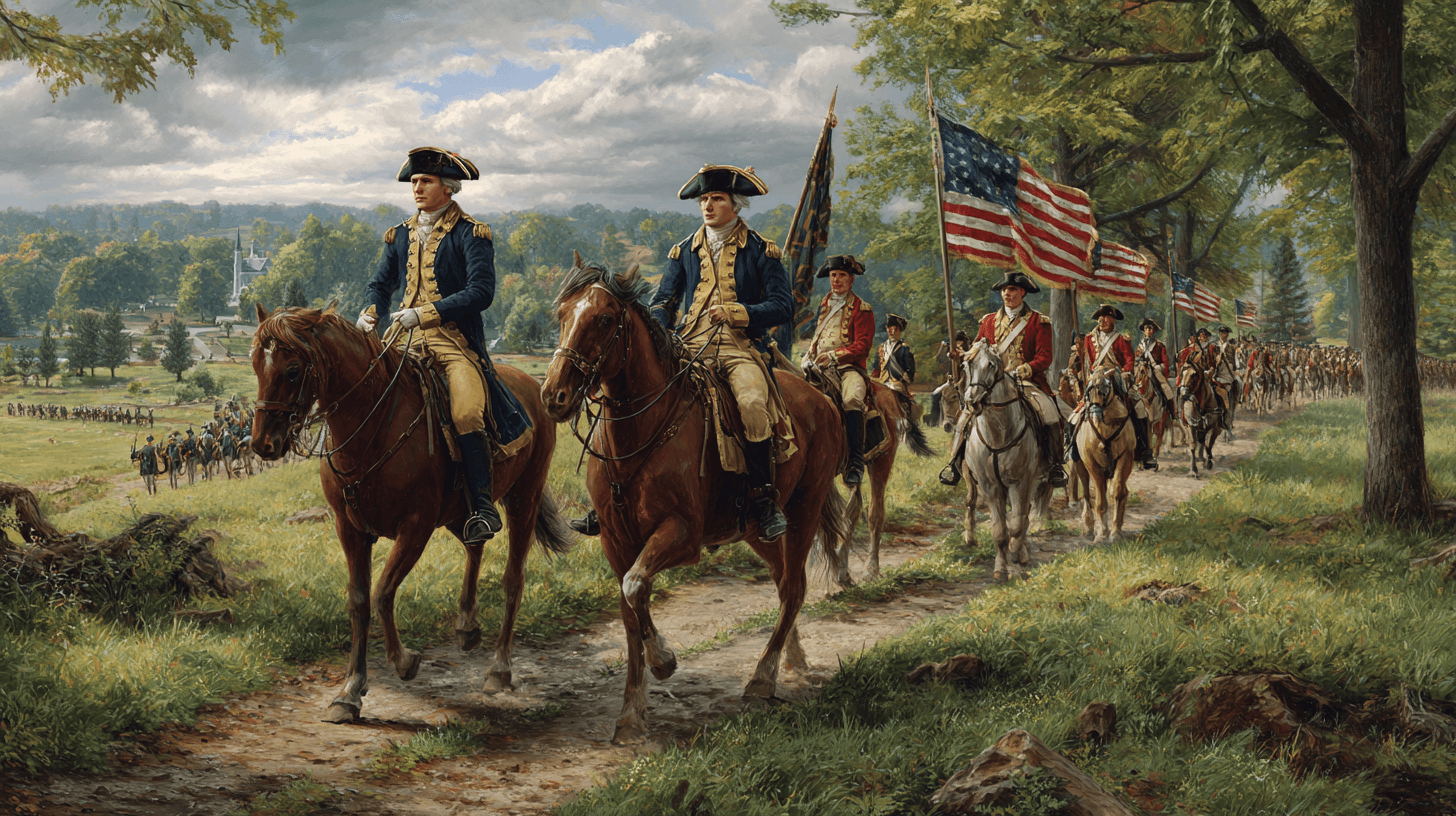
George Washington is often remembered as a brilliant tactician, but his most important strategic insight was recognizing what he could not do. He could not defeat the British army in a decisive, war-ending battle, at least not in the war’s early years. What he could do was keep the Continental Army intact.
This distinction shaped nearly every major decision Washington made. After losing New York City in 1776, he retreated rather than risking annihilation. He avoided large-scale confrontations that could destroy his army in a single afternoon, choosing smaller engagements and strategic withdrawals instead. Critics at the time and since have sometimes read this caution as weakness. It was closer to necessity, and it worked precisely because Britain’s goal required more than winning battles.
To restore colonial governments loyal to the crown, Britain needed to destroy the Continental Army as a fighting force and break the political will of the population. Washington denied them both. As long as an American army existed somewhere in the field, the rebellion had not been defeated, no matter how many cities changed hands.
Saratoga Changed the Nature of the War
If one moment marks the turning point of the war, it is the American victory at Saratoga in October 1777. A British force under General John Burgoyne, attempting to split the colonies by advancing south from Canada along the Hudson River, found itself cut off from supplies and surrounded by American militia and Continental forces. Burgoyne surrendered his entire army of roughly 6,000 men.
The military significance was real but not overwhelming on its own. The diplomatic significance was enormous. Saratoga convinced France that the American cause was viable enough to justify open military support rather than the covert aid it had already been providing. Without evidence that Americans could actually defeat a British army in the field, French intervention might never have materialized, and without French intervention, the war’s outcome could easily have gone the other way.
The War Britain’s Own Public Grew Tired Of
Military and diplomatic factors explain much of the story, but they do not explain everything. Public opinion in Britain mattered as well, and it shifted meaningfully as the war dragged on.
The conflict was expensive, difficult to justify to a public increasingly aware of colonial arguments about representation, and complicated further once France and Spain joined the fighting and threatened British interests closer to home. As the war expanded from a colonial rebellion into a broader European conflict, British leaders faced growing pressure to cut losses in America and focus resources on more immediate threats.
By 1782, after the surrender at Yorktown made clear that reconquering the colonies would require resources Britain could not easily spare, Parliament voted to end offensive operations in America. Lord North’s government fell shortly afterward. The decision to negotiate was made in London, not on any American battlefield, and it reflected a calculation about cost and priority as much as a verdict on the fighting itself.
What Popular Memory Gets Wrong
Popular memory of the Revolution often centers on scrappy militia outshooting disciplined redcoats through superior marksmanship and guerrilla tactics. This image contains some truth but obscures a more important reality: the war was won primarily through endurance, alliance-building, and strategic patience rather than through tactical innovation on the battlefield.
The Continental Army under Washington gradually became a more conventional, disciplined fighting force, particularly after training under the Prussian-trained officer Baron von Steuben at Valley Forge during the winter of 1777 to 1778. Steuben’s drilling transformed ragged, inconsistently trained troops into a unit capable of executing coordinated maneuvers, something that mattered greatly in later engagements. The war was not won by amateur riflemen alone. It was won by an army that learned to fight in a more professional manner while still benefiting from geography, foreign support, and the patience to avoid catastrophic defeat.
It is also worth noting that American success was far from guaranteed even after Saratoga and the French alliance. Britain nearly succeeded in a southern strategy beginning in 1778, capturing Savannah and Charleston and inflicting serious defeats on American forces in the Carolinas. The war’s outcome remained genuinely uncertain until Yorktown, and contemporaries on both sides understood this. Historians continue to debate how close Britain came to a negotiated settlement that would have preserved partial colonial autonomy short of full independence, had the war’s momentum shifted only slightly differently in its final years.
Why the Outcome Still Matters
The American victory did more than create a new nation. It demonstrated that a determined population, fighting on favorable terrain with outside support, could outlast a global superpower that lacked a clear path to decisive victory. That lesson would echo through later conflicts, from colonial independence movements to twentieth-century wars where military dominance failed to translate into political control.
It also established a template for how alliances could reshape a conflict’s outcome. France’s intervention was not driven by ideology but by strategic self-interest, and that pragmatic calculation proved just as decisive as any battlefield courage. Understanding the Revolution accurately means recognizing that idealism and self-interest worked together, not that one triumphed over the other.
The Real Explanation
The American Revolution did not succeed because thirteen colonies were stronger than the British Empire. It succeeded because Britain could never fully bring its strength to bear across an ocean, against an army that refused to be destroyed, in a war that eventually cost more than the British public was willing to pay.
Washington’s genius was not in winning battles but in understanding that he did not need to. He needed only to remain undefeated long enough for distance, cost, and foreign rivalry to do the rest. That patience, more than any single confrontation, is what turned a colonial rebellion into a nation.