Why the Middle Ages Ended and the Renaissance Began
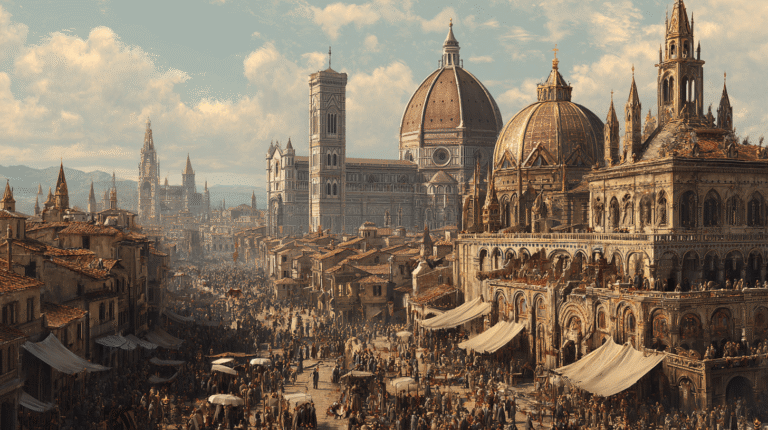
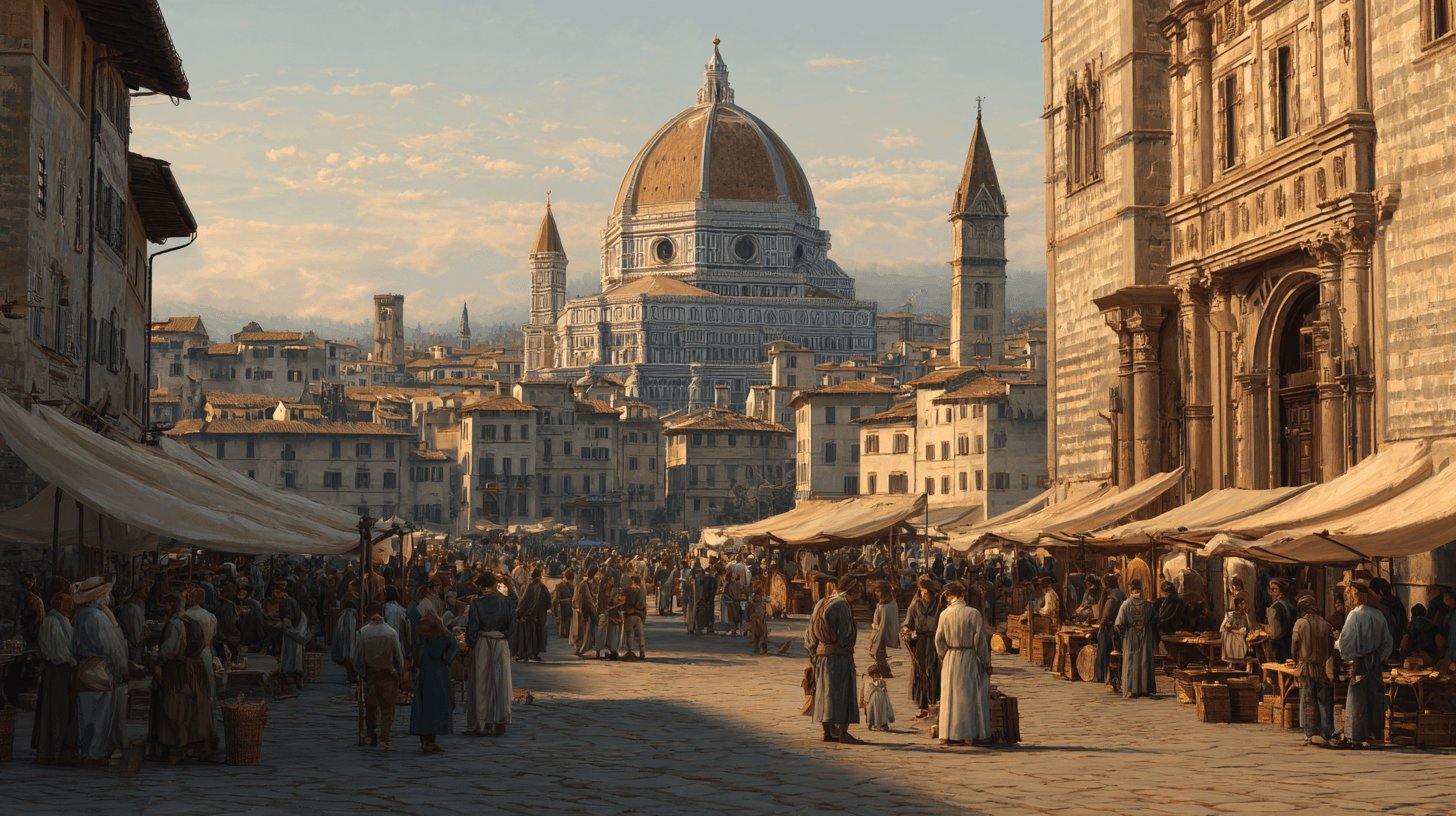
In the 1330s, Florence was one of the wealthiest cities in Europe, its wool merchants and bankers extending credit across the continent. By the 1350s, nearly half its population was dead. Historians still debate exactly how a civilization absorbs a shock of that size, but one thing is clear: the world that emerged from the wreckage did not simply rebuild the old order. It began, slowly and unevenly, to build something different.
That difference eventually acquired a name — the Renaissance — but the label can be misleading. It suggests a single moment when Europe woke up from a long medieval sleep and rediscovered reason, beauty, and ambition. The reality was messier. The Middle Ages did not end because people suddenly grew curious after centuries of incuriosity. They ended because a series of economic, demographic, and intellectual pressures converged in a way that made the old medieval order harder to sustain and a new one possible.
Understanding that convergence means asking a more precise question than “what caused the Renaissance.” It means asking what actually broke down in medieval society, what new forces filled the gap, and why Italy, of all places, became the staging ground for the change.
The World Before the Break
By the early 1300s, medieval Europe ran on a fairly stable set of arrangements. Land was the primary source of wealth, and most of it was controlled by a hereditary nobility and the Catholic Church. Peasants worked that land under feudal obligations that had changed little in generations. Knowledge was concentrated in monasteries and a handful of universities, transmitted mainly in Latin, and organized around a worldview in which theology explained nearly everything worth explaining.
This system was not stagnant. Trade networks connected Mediterranean ports to northern Europe, and cities like Venice, Genoa, and Florence had already built substantial commercial economies. But wealth from trade still operated inside a social order built for an agricultural, land-based world. The people getting rich from commerce had money without the traditional forms of status, and the institutions that controlled learning had authority without much competition. That imbalance was already a source of tension. It took a catastrophe to break it open.
A Plague That Rewrote the Rules of Labor and Land
The Black Death arrived in Europe in 1347 and killed an estimated 30 to 50 percent of the population within a few years. The immediate story is one of horror: overwhelmed cities, abandoned villages, and a psychological shock that touched nearly every family. But the plague’s long-term effect on medieval society was, in a strange way, structural rather than purely tragic.
With so much of the workforce gone, surviving laborers suddenly had leverage they had never had before. Landowners who needed workers to farm their fields had to compete for a much smaller labor pool, which pushed wages up and gave peasants room to negotiate terms that would have been unthinkable a generation earlier. In many regions, this accelerated the decline of serfdom, the system that had tied laborers to the land under obligation to a lord.
At the same time, a great deal of accumulated wealth—land, money, workshops, trade goods—passed to fewer surviving heirs. Some of that wealth concentrated in the hands of merchant families who were already positioned to expand their commercial activity rather than simply sit on inherited land. The plague did not create capitalism, but it did loosen the rigid link between land and status that had defined the medieval economy. It gave merchants an opening, and merchants used it.
The Rise of Merchant Cities and a New Kind of Wealth
Nowhere took advantage of that opening more effectively than the city-states of northern and central Italy. Florence, Venice, Genoa, and Milan were not feudal territories ruled by a distant king. They were commercial republics and city-states run largely by merchant elites who had grown wealthy through banking, textiles, and long-distance trade.
The Medici family in Florence is the clearest example of how this new kind of power worked. Their fortune came from banking, not land, and their influence rested on financial networks that stretched across Europe rather than on hereditary title. Wealth built this way did not automatically confer the prestige that noble birth had traditionally guaranteed, so families like the Medici looked for other ways to establish their standing. One of the most effective was patronage: funding artists, architects, and scholars whose work reflected well on the family that paid for it.
This is a crucial and often underappreciated mechanism behind the Renaissance. The period’s extraordinary artistic output was not simply the result of a sudden explosion of talent. It was the result of new patrons with commercial wealth who needed cultural prestige that the old aristocratic order could not sell them, and who had strong incentives to fund exactly the kind of ambitious, innovative work that would make their names memorable.
Scholars, Manuscripts, and the Rediscovery of the Ancient World
Money alone does not produce a cultural movement. It needs ideas to fund. In the case of the Renaissance, those ideas came substantially from a renewed engagement with classical antiquity—the literature, philosophy, and rhetoric of ancient Greece and Rome.
Medieval scholars had never been entirely cut off from classical texts, but access to the full range of Greek philosophy and literature had long been limited in Western Europe. That began to change as scholars, often working through Islamic centers of learning in Spain and the eastern Mediterranean, recovered and translated works that had been preserved more thoroughly outside Western Christendom. The gradual decline of the Byzantine Empire, which culminated in the fall of Constantinople in 1453, pushed additional Greek-speaking scholars and their manuscripts westward into Italy, reinforcing a process that was already underway.
What these scholars promoted came to be called humanism: an intellectual movement that studied classical texts not primarily as sources of Christian doctrine, but as models of eloquent argument, civic virtue, and human potential. Figures like Petrarch, often described as an early humanist, argued that ancient writers had understood something valuable about human experience that medieval scholasticism had lost sight of. This was not a rejection of Christianity. Most humanists remained devout. It was, instead, a shift in emphasis—from a worldview centered almost entirely on the next life toward one that also took seriously the achievements and dignity of life in this one.
A Machine That Multiplied Ideas
None of this intellectual ferment would have spread nearly as fast without a technological change that arrived at almost exactly the right moment: the printing press, developed by Johannes Gutenberg in the German city of Mainz around 1440.
Before Gutenberg, books were copied by hand, a slow and expensive process that limited most texts to a small number of manuscripts held by monasteries, universities, and wealthy collectors. Movable-type printing did not merely make books cheaper. It made it possible to produce many identical copies of the same text quickly, which meant ideas could travel across Europe at a speed no medieval institution had ever had to contend with.
The printing press did not create the Renaissance’s ideas, but it multiplied their reach dramatically. Humanist texts, classical translations, and eventually scientific and religious works could circulate to a far wider readership than any hand-copied manuscript tradition allowed. A scholar in Florence and a merchant in Antwerp could, within a few years, be reading the same edition of the same text. That kind of shared intellectual reference point had simply not existed at scale before.
What the Church Could No Longer Control
For centuries, the Catholic Church had functioned as medieval Europe’s primary institution of both spiritual authority and intellectual life. It ran the universities, trained the scribes, and shaped what counted as legitimate knowledge. The developments described above did not destroy that authority, but they steadily reduced its monopoly.
Wealth that bypassed the traditional land-based aristocracy also, in practice, bypassed some of the informal channels through which the Church had shaped elite culture. Humanist scholarship, with its interest in pre-Christian antiquity, opened intellectual space that was not primarily theological. And a printing press that could reproduce any text, not only approved religious material, made it much harder for any single institution to control what ideas reached a literate public.
This shift was gradual and did not amount to secularization in the modern sense. Renaissance patrons commissioned religious art constantly, and humanist scholars were overwhelmingly Christian. But the intellectual and cultural center of gravity had begun to move outside institutions the Church directly controlled, a change that would have far larger consequences a century later, when print helped a different set of ideas—those of the Protestant Reformation—spread far beyond what earlier religious dissenters had ever managed to achieve.
What Popular Memory Gets Wrong
The most persistent misunderstanding about this period is the idea of a clean break: centuries of medieval darkness followed by a sudden Renaissance dawn. Contemporary historians largely reject this framing. The Middle Ages were not simply a period of stagnation; they produced sophisticated theology, remarkable Gothic architecture, functioning legal systems, and expanding universities. The Renaissance, in turn, did not spring from nothing—it built directly on medieval commercial networks, medieval Latin scholarship, and even medieval religious institutions that funded much of its greatest art.
It’s also a mistake to treat the Renaissance as something that happened to ordinary people the way it happened to elite patrons and scholars. For the vast majority of Europeans, daily life in 1500 still involved agricultural labor, limited literacy, and religious institutions that remained central to community life. The intellectual and artistic transformation associated with the Renaissance was concentrated among an educated, urban, and often wealthy minority long before its effects diffused more broadly.
Why the Transition Still Matters
The shift from medieval to Renaissance Europe illustrates something broader about how major cultural transformations actually happen. They rarely occur because people simply decide, collectively, to think differently. They occur when the underlying conditions that sustained an older way of organizing knowledge, wealth, and authority weaken enough to let alternatives take hold—and when new tools exist to spread those alternatives quickly.
The Black Death did not cause humanism, and Gutenberg’s press did not invent classical scholarship. But the demographic shock that loosened feudal labor relations, the commercial wealth that funded new forms of patronage, the recovered texts that offered a different model of human achievement, and the printing technology that could carry those ideas across a continent all arrived within roughly a century of one another. Any one of these developments alone might have produced only a minor cultural adjustment. Together, they were enough to end one era and begin another.
The Central Insight
The Renaissance is often remembered as an age of individual genius—Leonardo, Michelangelo, Machiavelli—and it certainly produced extraordinary individuals. But genius alone does not explain why this particular period, in this particular place, generated so much of it at once. The Middle Ages did not end because Europeans became smarter or more curious than their ancestors. They ended because the economic and institutional scaffolding that had organized medieval life for centuries came under sustained pressure from multiple directions simultaneously, and enough of that scaffolding gave way to let a different kind of civilization take shape.
What replaced it was not fully modern, and it was not free of the inequalities and religious conflicts that would continue to define European life for centuries. But it was a civilization in which commercial wealth could buy cultural prestige, in which classical antiquity offered an alternative to purely theological explanation, and in which a printed page could carry an idea further and faster than any single institution could contain. That combination—not any single invention or genius—is what actually separates the medieval world from the one that followed it.